



When people go down the aisle, they can hardly imagine that they will have an unhappy marriage. But, unfortunately, based on the research, 35% of all couples experience marital issues that result in disappointment, frustration, a feeling of insecurity, and an overall negative mood in their union. If you feel like your married life experiences lows rather than ups, you should stay on this page a little longer. Check out the signs, undergo the quiz, and learn the consequences of unhappy marriages. Furthermore, make the most of the useful tips that will help you get rid of the toxicity in your family, whether you are going to save your love or split up.
Main Signs of Unhappy Marriage
Have you noticed that something has changed in your married life? Do you consider those changes to negatively affect your relationships? While each couple experiences happy and sad moments, there are some things that identify unfulfilling love affairs. The relevant study notes that chronically abusive relationships affect human well-being and even reduce their lifespans. If you want to live a healthy and happy life, recognize these unhappy signs your marriage is failing before it’s too late.
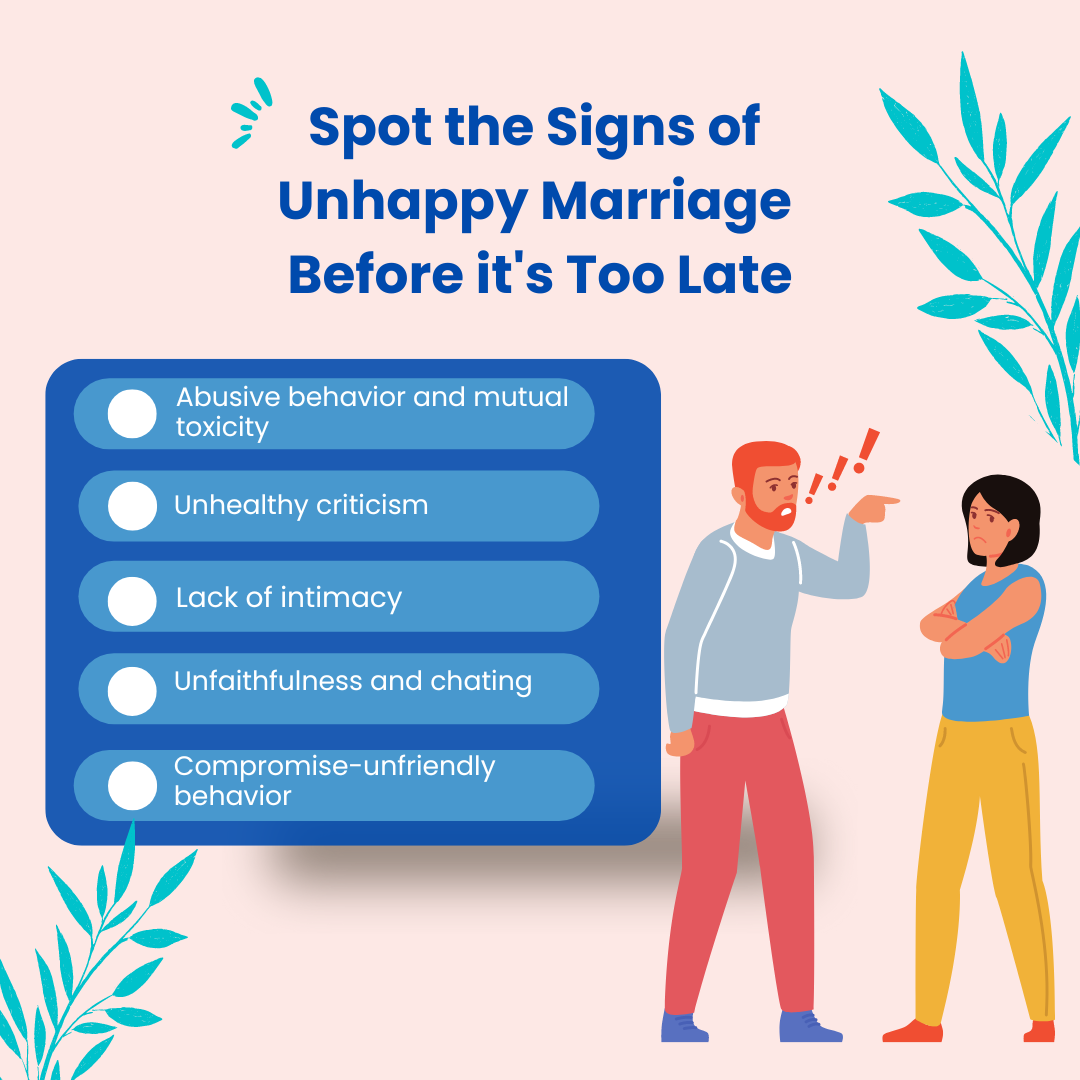
Abusive behavior and mutual toxicity
If you have ever noticed aggressive actions and shared hostility in your unity, your relationships might go to their logical end. No one should ever have to put up with abuse; it is never acceptable in any kind of affairs. If you are experiencing harmful dynamics in your marriage, you must get help or break up. Remember that abuse can take many different forms. Aside from verbal or emotional abuse, there is also physical harm, which should be addressed as soon as one of the partners notices it.
Read also: How to Get a Girl to Like You?—Learn Winning Strategies.
Unhealthy criticism
If one of the partners overdoes it with critical thoughts and puts down another partner, it is definitely a warning sign that may lead to a broken relationship. Here it is necessary to consider whether the criticism is constructive. If not, soon it will be complemented with defensiveness, contempt, and stonewalling, which are likely to break someone’s heart. This kind of behavior can chip away at trust and intimacy, creating a rift between partners that might be tough to heal.
Lack of intimacy
The statistics show that 20% of unhappy couples have sexless relationships. That is why a lack of intimacy is one of the main signs a man is unhappy in his marriage. Nevertheless, the same applies to women as well. Nevertheless, even if your closeness leaves much to be desired, it doesn’t mean that your marriage failed. It is possible to return the affection if both partners really want it. Anyway, the lack of sex implies some issues in your bonds, which need to be resolved shortly.
Unfaithfulness
Infidelity hurts like hell, regardless of whether you have been close to each other or not. Although divorce or separation is frequently the result of cheating, this is not always the case. Some people can tolerate unfaithfulness and move forward. Is it your case? Actually, it depends on the personality traits of both partners, circumstances, and additional factors that lead to cheating. Moving on from infidelity will require couples therapy at least.
Compromise-unfriendly behavior
Does one of the partners always blow the whistle on nothing? Well, it is always possible to find a reason for a fight, but why? If such a thought as “I am so depressed and lonely in my marriage” pops up in your mind and you are sick and tired of constant arguments, you are likely to have an unhappy marriage. Any successful relationship must involve compromise. You may be in a toxic affair if your spouse is wholly one-sided in your marriage and finds it difficult to find common ground with you or will not even try.
Read also: 7 Reasons I Love You: Make Your Crush Feel Special.
Unhappy Marriage Quiz
Feel like you have a damaging relationship? If you have hesitation about whether your marriage is happy or not, this quiz will certainly help you find the answer to your question. Nevertheless, aside from undergoing the quiz, it is necessary to analyze all signs of your rocky family life to make a formal decision about which actions to take further.
Why Am I So Unhappy in My Marriage?
“I’m so unhappy in my marriage but I can’t leave.” Do you have such thoughts? Then you will certainly need to take a peek at the reasons why people feel unfulfilled in their relationships. Check them out to see that you are not alone in going through a harmful affair.
- You are not in the same boat anymore. Perhaps you have become more distant from each other and the things that used to work no longer do. There is a feeling that you are living different lives within the same house.
- You blow your tops each time you have a conversation. Constant arguments and disagreements can wear you down. If you are always at each other’s throats, it’s no wonder you are feeling fed up.
- The flame has burned out. Even when you are together, you may feel alone and distant if the romance and intimacy have completely gone. The lack of affection often results in unhappiness in both partners.
- You both feel like you are carrying all the weight. It can be draining and leave you feeling undervalued if you are the one who always goes above and beyond while your spouse just coasts along.
- Trust issues are eating you up. It is difficult to feel safe and content if trust is broken, whether it is because of cheating or dishonest behavior. When one of the partners violates the trust, it is quite difficult to restore the relationship.
- You both feel like you fall into the trap. Sometimes, you just feel stuck in a rut, and the relationship isn’t giving you the freedom or happiness you are looking for. The last thing a man or woman wants is to feel like a rat in the trap.
Should I Stay in an Unhappy Marriage? — Answers and Tips
Would you like to discover how to be happy in an unhappy marriage? Or are you all about breaking all those bonds and starting a new page in your life without abuse and poisonous behavior? It is a personal call on what to do with hostile family life. Nevertheless, we still compile valuable tips that will help you find a perfect way out of your tough situation.
Communicate your issues
The cornerstone of a successful relationship is constructive talk, which covers all the twists and turns of your love affairs. Ask your spouse to have a heart-to-heart while looking into each other’s eyes. Lay all your cards on the table and learn to listen. Having a conversation can sometimes help to resolve even the most severe conflicts. You can even play a game by asking and answering questions that bother you. It will help you be more wholehearted with each other.
Bring back your affection
As you get sucked into the daily grind, it is easy to forget about the little things that used to make you happy. What can you do to refresh your relationship if you see that it is worth saving them? Try bringing back date nights, surprise gestures, or even just hanging out together without any distractions. Sometimes a nice change for both of you can make a big difference when it comes to fixing your family issues.
Don’t bottle your feelings up
If something is bothering you, don’t keep it. Try to demonstrate all your worries to your partner. Who knows? Maybe everything isn’t that serious and it is just your imagination that made a big problem out of a tiny issue. Holding things in will only make you more resentful. Instead of allowing problems to accumulate, take care of them as they arise. Moreover, it may serve as another reason to communicate and build trust in your relationship.
Analyze your actions
Sometimes, the best way to refresh love affairs is to start with self-analysis. Perhaps you need to focus on managing your stress or finding happiness on your own terms outside of your bonds. Also, it is necessary to reassess your feelings toward your partner. Do you still love your spouse? How will you feel if you split up? Will you feel relief? Answer these questions to understand your real relationship goals.
Learn to appreciate each other
Good lovers are good partners — this is the most proven rule of all successful love affairs. Even if your spouse makes some tiny good things for you, you will need to value such gestures. Or, a better way, give even more in return. Appreciation goes hand in hand with mutual understanding and support. Once you follow this rule, you will build a strong foundation for your relationship, which no one can undermine.
Seek professional help
Calling in professional help might be the best decision for those who think they lost the spark. A relationship coach or therapist will help you identify the ground for your misconception and give tips to either cure your bonds or find a way how to get out of a marriage. Dealing with conflicts in a healthy way is essential, whether you are going to save your family or move forward.

Consequences of Being in Unhappy Marriage
If you both made a formal decision to stay in an unhealthy marriage, be ready for certain consequences that may harm your heart and soul and worsen your overall well-being.
- Negative effect on your children. The research notes that all arguments and fights that happen between partners affect their children drastically. Sleep problems, academic challenges, and physical health concerns — these are just some outcomes of an unhappy marriage that have an impact on the whole family.
- Anxiety that results in depression. Both spouses experience significant stress during their breakdowns in understanding and yelling bouts. It may have a destructive impact in the long run. Depression is very hard to cure, so it is better to prevent such consequences.
- Decreased self-worth. If people are constantly arguing with each other, it will lower their self-esteem for sure. And you know, reduced self-respect has an impact on multiple life spheres, compromising your career goals, and self-care, and leaving no chances for mending your bond.
- Less chance of finding happiness elsewhere. The current toxic relationships may engage both partners in a circle of constant romantic failures, even if they decide to find new love. You know that giving in to your partner’s happiness will probably mean giving up on your dream.
- Emotional burnout. Being engaged in a miserable family life can really take a toll on your mental health. Because of the ongoing stress and discontent, you may feel exhausted and like you are running on empty. There is no way to recharge the battery, so you will continuously burn like a candle.
There are only a few consequences of an unhappy marriage. But they can be even more if you continue to go through that toxic dynamic.
Summing Up: Is it Better to Divorce or Stay Unhappily Married?
When a marriage does not work out, you may begin to feel more like roommates than lovers. The emotional distance can grow, and before you know it, you are living separate lives under the same roof. Unhappy marriage may lead to different emotional swings and even mental problems. While it is only your call whether it is better to divorce or stay in a rocky relationship, it is necessary to take action to be affected by as few negative outcomes as possible.
Of course, there is no need to rush the divorce. You may work on your family life first by incorporating all the above-mentioned tips into your everyday routine. If things still go south, you may need to end those destructive affairs to have a chance for happiness in a new life.
If this publication supported your long-term vision, there is more detailed guidance in the healthy partnership blog, where stability, trust, and loyalty are analyzed in depth. Following updates keeps your approach disciplined and focused. Discipline in dating prevents costly missteps. Real outcomes require decisive movement. When you feel prepared, start building serious connections on the trusted international partner network and take control of your future.
What Are the Pathological Markers of a Dysfunctional Marital System?
Identifying an unhappy marriage requires a cold, analytical assessment of the communication patterns and emotional climate within the domestic sphere. One of the most prominent markers is the transition from constructive conflict to chronic emotional withdrawal or "stonewalling," where one or both partners cease to engage in meaningful dialogue. This defensive mechanism signals a breakdown in the safe psychological space necessary for vulnerability, leading to a state of parallel existence rather than partnership. When the ratio of positive to negative interactions falls below the critical threshold, the relationship enters a phase of emotional bankruptcy, where resentment becomes the primary filter for all interpersonal exchanges.
Furthermore, the presence of "The Four Horsemen"—criticism, contempt, defensiveness, and stonewalling—serves as a highly accurate predictor of systemic marital failure. Contempt, in particular, acts as an acidic agent that erodes the foundation of mutual respect, manifesting through sarcasm, eye-rolling, or hostile labeling. This pathological shift is often accompanied by a total cessation of shared laughter and physical affection, creating a sterile environment devoid of intimacy. These indicators suggest that the marriage has moved beyond a temporary crisis into a state of structural unhappiness, requiring immediate intervention to prevent total psychological disintegration of the union.
How Does Chronic Marital Stress Manifest in Physical and Mental Health?
The impact of an unhappy marriage extends far beyond emotional dissatisfaction, manifesting as a significant threat to the physiological and psychological integrity of both individuals. Chronic interpersonal conflict triggers a persistent activation of the Hypothalamic-Pituitary-Adrenal (HPA) axis, resulting in elevated systemic cortisol levels. This prolonged stress response suppresses the immune system, increases the risk of cardiovascular disease, and disrupts metabolic functions. The body, in a state of constant "high alert," begins to reflect the internal chaos of the relationship through psychosomatic symptoms such as chronic tension headaches, digestive disorders, and persistent fatigue.
From a mental health perspective, the erosion of a primary attachment bond serves as a primary driver for clinical depression and generalized anxiety disorders. The constant state of hyper-vigilance required to navigate a hostile or unpredictable domestic environment depletes cognitive resources and reduces emotional resilience. Partners often experience a profound loss of self-esteem and a sense of learned helplessness as their efforts to rectify the situation repeatedly fail. This cognitive decline often leads to a diminished capacity for professional performance and a withdrawal from social support networks, creating a feedback loop of isolation that exacerbates the original marital distress.
What Are the Strategic Steps for Assessing the Viability of the Relationship?
When faced with chronic marital unhappiness, the individuals must undertake a rigorous audit of the relationship’s core values and the potential for systemic change. This involves distinguishing between "perpetual problems" that are rooted in personality differences and "solvable problems" that stem from poor communication or situational stress. A viable strategy for assessment includes the following focal points:
- analyzing the willingness of both partners to accept responsibility for their contribution to the current dysfunction;
- evaluating the presence of remaining "fondness and admiration" as a reservoir for potential repair;
- identifying whether the core values of both individuals still align or have diverged irreconcilably;
- determining if there is a mutual commitment to engaging in professional marital therapy or intensive intervention;
- assessing the impact of the marriage on the developmental health and psychological safety of any children involved.
This analytical process requires temporary emotional detachment to view the marriage as an external structure. If the audit reveals a total absence of mutual respect or a persistent refusal to engage in the work of repair, the viability of the union is significantly compromised. However, if there is a shared recognition of the dysfunction and a collective desire to rebuild the "sound relationship house," the current unhappiness may serve as a painful but necessary catalyst for transformation. The goal is to move from reactive emotional pain to proactive decision-making, ensuring that the next steps are based on objective reality rather than temporary impulse.
How Can Couples Implement Effective Repair Attempts and Re-synchronization?
The restoration of an unhappy marriage depends on the successful implementation of "repair attempts"—specific verbal or non-verbal signals intended to de-escalate tension during conflict. These attempts serve as a cognitive "reset" that prevents a disagreement from devolving into a hostile exchange. Successful repair requires both a courageous sender and a receptive receiver who is willing to acknowledge the olive branch, even in the heat of an argument. Re-synchronization also involves the intentional rebuilding of the "Love Map," which is the psychological space where partners store information about each other’s inner world, dreams, and current stressors.
To move from unhappiness to a functional connection, couples must prioritize the ritualization of positive interactions to counteract the accumulated negativity. This includes the practice of "bidding for connection"—small gestures or comments intended to elicit a positive response from the partner. Consistently responding to these bids with interest and warmth builds emotional capital, which acts as a buffer against future conflicts. Furthermore, adopting a "softened start-up" when raising concerns prevents the immediate activation of the partner's defensive systems. By systematically replacing criticism with specific requests for change, the couple can slowly rewire their interactive patterns, moving away from a culture of blame toward a culture of mutual support and appreciation.
When Is the Transition to Dissolution the Most Psychologically Healthy Option?
Despite the capacity for human change, there are instances where the most constructive path for long-term mental health is the conscious dissolution of the marriage. This is particularly true in cases involving chronic infidelity, untreated addiction, or any form of physical and psychological abuse. In such scenarios, the "unhappiness" is a symptom of a fundamental violation of the marital contract that renders the environment toxic for personal growth. Choosing to end a marriage in these circumstances is an act of self-preservation and a refusal to participate in a cycle of mutual destruction.
The decision to separate should be viewed through the lens of long-term trajectory rather than immediate relief. If the marriage consistently requires the suppression of one’s core identity or if the emotional cost of staying far outweighs any potential benefit, dissolution becomes a strategic necessity. A "healthy" divorce involves a commitment to minimizing collateral damage, particularly for children, and focusing on the establishment of functional co-parenting or independent lives. Ultimately, the goal of navigating an unhappy marriage is to achieve a state of emotional integrity—either through the radical transformation of the union or through the courageous choice to depart and rebuild a life based on autonomy and peace.

Robert Smith is a professional writer and relationship expert who has devoted his life path to giving advice to those seeking love outside their countries. Robert was able to combine his two passions—his love of writing and his talent for international love affairs. The author has developed his dating strategies based on his investigations into the international dating niche and his own experience.