



As much as we would like to avoid it, conflict is an inevitable part of life in all contexts, and romantic relationships are no different. “My wife yells at me” — a common problem thousands of men are trying to cope with to save their union. The latest statistics show that one in three victims of domestic abuse is male, equating to 751,000 men (3.2%) and 1.38 million women (5.7%).
So, if you have found yourself constantly wondering or pleading: “Why is my wife yelling at me so much?” or “Please, stop yelling!”, you will need to delve deeper into this issue before it becomes a reason to threaten your family life. Do not rush to draw conclusions, keep your mind cold and continue reading. This expert guide will be a tool to heal the bond between you and your beloved woman.
🗣 Is Yelling Toxic in a Relationship?
Constant screaming from the partner’s side on every occasion isn’t adequate behavior that can be considered emotional abuse. Over time, yelling contributes to the dynamic of developing toxicity in your relationship, creating resentment and other barriers to a happy marriage. This can lead to stronger tension and less communication between partners. If a wife yells at husband, it fills him with unpleasant memories and negative emotions.
For people who used to hear a raised voice, it can cause feelings of fear, anxiety, and discomfort. An unpleasant experience with a screaming wife can lead to negative stereotypes and prejudices, as well as lasting psychological effects.
✍🏻 It is known that constant yelling bouts in the family can result in psychological problems such as depression, anxiety, and lowered self-esteem. The lack of peace and harmony in communication between partners can significantly affect the quality of the relationship and make it toxic.
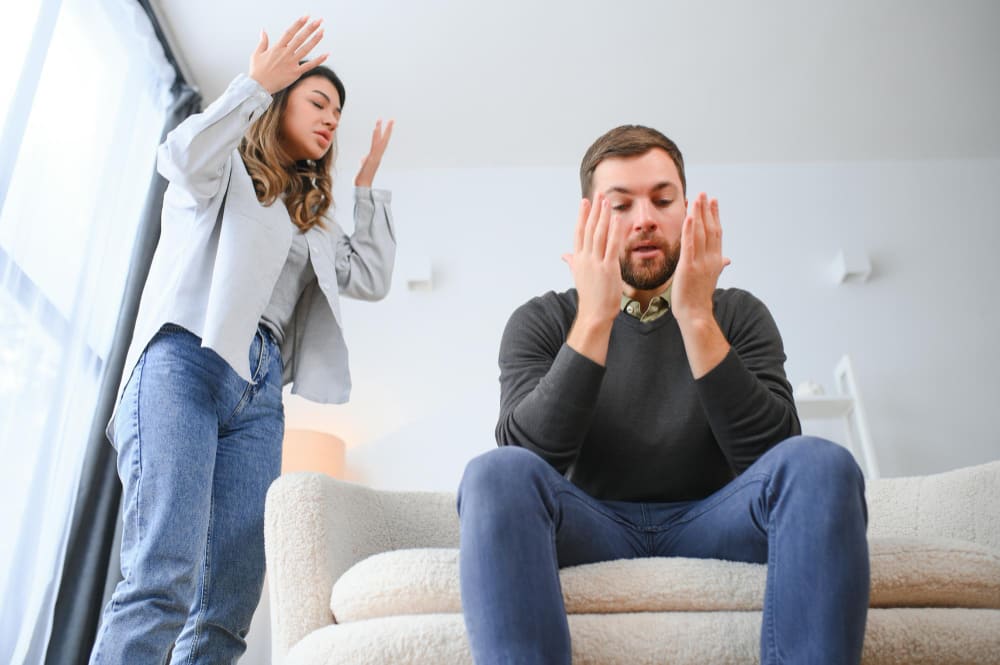
👀 Why My Wife Yells at Me? — Common Reasons
Raising the voice is a way of showing one’s emotion and expressing their thoughts and feelings. Some people snap during arguments or conflicts to persuade others to listen to them. Others may scream when they are stressed or nervous. “Why does my wife yells at me?” One of our main goals is to share the most common reasons why people want to yell at their spouses.
Read also: Online Dating Services or Real Rendezvous? Choose the Best for You.
🎤 Striving to get your attention
One of the reasons for your wife to speak out loudly is disagreement or dissatisfaction. When she feels that you are not listening or not accepting her arguments, a woman may start screaming to get your attention and make you think about her. This may be in response to injustice, mistreatment, or disrespect for her boundaries.
✍🏻 “Why is my wife yelling at me?” Try to analyze whether her screaming may be a consequence of the way you treat your spouse. If this is the case, pay attention to how you act with your soulmate, listen to what she says, and do things that could fuel your feelings for peace.
🎤 An urge for dominance
Another reason for a wife’s anger is to try to make you vulnerable. Therefore, she may assert herself and persuade you to change your opinion on a certain matter. This could stem from a lack of confidence in herself or a need to be in charge of the circumstances.
🎤 Lack of self-control
You wonder: “Why does my wife yell at me?”. But do you know that some people raise their voices because they don’t know how to deal with their life’s difficulties? Your partner yells because she thinks it is the only way to cope with troubles; she needs help and the possibility of learning to control her emotions. In such a case, it is recommended to seek help from a psychologist.
🎤 She feels threatened
Most often, people who show aggression toward the world have sensitive personalities. Thus, they try to protect their inner world with the help of screaming. Whenever your wife has a sense of danger, she believes that snapping is the only correct and effective method to improve the situation.
🕵🏻♂️ An expert tip: If your partner tends to be aggressive, be extremely cautious, she may just be provoking you to retaliate. At that moment, you think: “My wife screams at me!”. It is very important to remain calm and not respond in the same way to avoid escalating the conflict and other undesirable consequences.
🎤 Wrong beliefs
Each of us has a certain pattern of family behavior. Your wife may have grown up in a family where raising a voice is considered normal. She has clearly memorized that screaming is a way to resolve any fight. Yelling may also reflect her defensive reaction to stress.
🎤 She feels helpless and frustrated
“What if my wife yells at me?” Pay attention to your partner’s emotional state: she may feel anxious or depressed. Her outward aggression is actually a resentment against herself. Lack of funds, instability, and material insecurity are frequently the causes. Who knows? Maybe she feels helpless and disappointed and reveals her emotions in such a destructive way.
Read also: Muslim Dating—Best Advice on Dating a Muslim Woman.
🎤 Unmet needs
“My wife snaps at me all the time…” A woman becomes angry when she can’t communicate properly about her needs or desires to her partner. Most often, it manifests itself when the lady asks her husband for something and he gives empty promises instead. The unmet need is postponed, and the woman accumulates tension. She perceives her request as being overlooked.
🎤 Asking for help
Your wife is just as likely to be tired as you are, and her life energy may be at zero. If she reacts with screams to the mundane daily routine, extend your assistance. After all, through aggression and tension, she tries to unlock your concern for her.
🎯 What Do I Do if My Wife Yells at Me?
Do you feel uncomfortable every time your beloved speaks to you rudely? Let’s take a look at the most popular and effective ways of action that you could apply to reality to improve the situation and get rid of the problem. Put them into practice and see how quickly your relationship will change for the better.
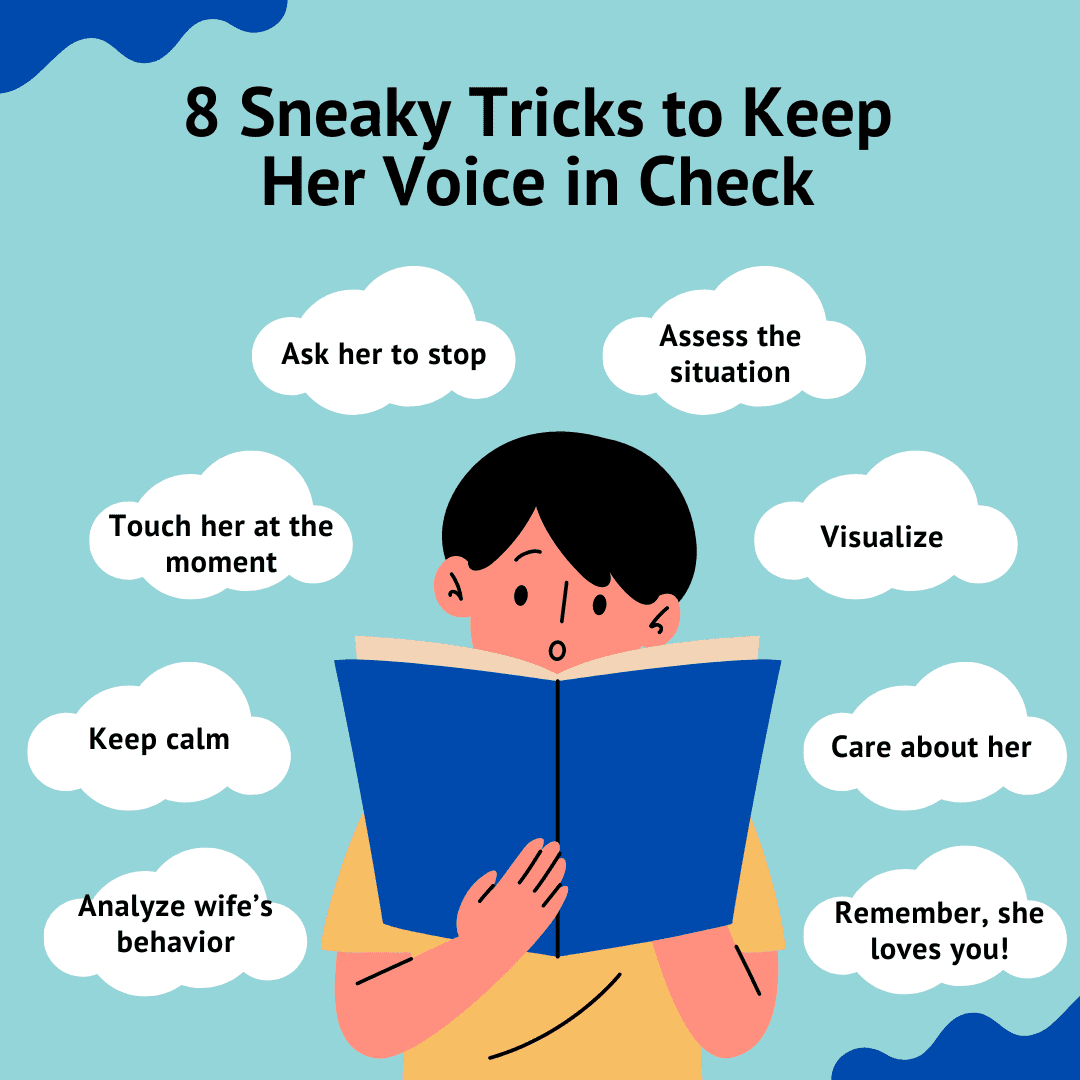
🪄 Analyze wife’s behavior
What exactly has been upsetting her lately? Maybe she had an argument with her boss or her new dress became tight. Who knows? Seek to determine whether such behavior has any objective explanations. Do not express your displeasure in response, but try to have a constructive talk.
🪄 Keep calm
Think about a scenario where your spouse speaks loudly and uses harsh language toward you. Now imagine yourself, completely calm and attentive, listening to her speech, displeasure, and yelling. There is no expression of dislike, indignation, or fear on your face. Look at your woman and say, “I want to understand you. I know you can’t talk about your pain any other way. I care about you very much.” Replay this situation several times in your mind.
The next time she yells, it will be much easier for you to resist the urge to get into a fight. Each time you do this, it will get easier. You’ll see how much your relationship will change when you start using this technique.
🪄 Touch her at the moment
During the argument, try simply touching your beloved’s arm or shoulder. This way, you will demonstrate that you care and are concerned about her. This is the working method because if you have a friendly attitude toward your partner, it will be difficult for her to keep yelling.
🪄 Ask her to stop
“My wife yells at me in public…” A quite simple but effective way to stop her screaming is to calmly ask her about it. You can say that you are uncomfortable with such a tone of voice when there are other people around; you just don’t take in the information at that moment. This approach is frequently effective when you’re subjected to unjustified yelling.
✍🏻 If the situation is critical and the fact that your wife is screaming all the time starts to scare you, consider whether you should be with her at the moment. Always make your own decisions and take responsibility for your well-being. All events in your life happen only with your permission.
🪄 Assess the situation
Take a moment to mentally distance yourself and analyze the situation objectively. You may be the reason for the wife’s screaming; you may have provoked the conflict by some action or word and didn’t notice it. Consider what is going on and what might trigger your soulmate to react this way.
🪄 Visualize
If you want your wife to stop yelling and her behavior to change, look at your relationship from another angle. Do this exercise every day: take a piece of paper and a pen, and describe the ideal bonds you want to have. Write as if it already exists. With a sense of gratitude, describe in detail the attitude of the woman toward you: how she behaves, how she communicates, and what feelings you are experiencing. Be sure that after this practice, there will be positive changes in your love affairs.

🪄 Do not forget about care and affection
To keep your love alive, don’t forget to show your feelings to the wife through your actions. Every woman needs signs of attention. Arrange romantic dates for her, invite the lady to dinner at a restaurant, say affectionate words, and don’t forget to give her small gifts once in a while.
🪄 Remember, she loves you!
With your partner’s feelings in mind, you must address those emotions and try to remedy them. Remember that your wife loves you and reacts positively when you prove your feelings as well. Don’t be surprised if your significant other asks questions like, “Where have you been all day?” or “What activities have you been engaged in recently?” Avoiding these questions will only make the situation worse, so answer honestly, apologize, ask for forgiveness, and discuss how the two of you can work together moving forward to ensure incidents like this don’t happen again.
🔑 Key Takeaways
We sincerely hope that after reading this article, you will give your love affair a boost and that thoughts like “My wife yells at me” will no longer bother you. Here is the bottom line:
- Relationships where one partner engages in abusive behavior like yelling are considered toxic and do not bring pleasure, joy, and happiness to both parties.
- Your wife may be screaming because she doesn’t know any other way to ask for help or get your attention.
- “Help my wife is yelling at me!” To stop your wife from yelling at you, stay calm and let her know that you don’t want to communicate in such a tone. Try to look at the situation from a different perspective.
- If your work will not yield any results, seek help from a therapist.
As an alternative, you can meet VictoriyaClub’s girls, who sincerely want to build a happy relationship and will never yell at their partners. Here, you can be sure that the women you create a rapport with have positive traits and angelic appearances.
Was the article above valuable because it gave you clear direction? Stay subscribed to the healthy relationship knowledge base for new posts on emotional stability, trust, and long-term compatibility. Regular updates build a strong foundation for serious choices. Serious choices lead to serious results. When you are ready to take the next step, start on relationship-focused dating service and begin meeting women aligned with marriage goals.
Does systematic shouting qualify as a form of domestic violence in modern realities?
In 2026, psychological and legal paradigms unequivocally classify systematic, uncontrolled shouting as a form of psychological (emotional) violence. Unlike a situational argument, violence is characterized by an imbalance of power and control, where shouting is utilized as a tool to suppress the subject's will, humiliate, and intimidate them. Psychologists note that the impact of verbal aggression on the male nervous system can be as destructive as physical impact, leading to the development of Post-Traumatic Stress Disorder (PTSD), diminished cognitive abilities, and chronic anxiety. If shouting is accompanied by insults, threats, or attempts at isolation, it represents a classic manifestation of an abusive pattern.
It is vital to understand that in 2026, the stigma surrounding "men as victims" is gradually dissipating, giving way to a rational analysis of safety. Domestic violence has no gender; its essence lies in the violation of personal boundaries and the infliction of harm upon a partner's psyche. Systematic aggression from a wife is often ignored by society as a "manifestation of temperament," yet analysts emphasize that any act of communication aimed at undermining a person's dignity through fear is destructive. Recognizing that shouting is not a "norm of family life," but a violation of the fundamental right to safety, becomes the first step toward de-escalating the conflict and seeking professional assistance.
Which 10 strategies help stop verbal aggression and protect oneself?
Stopping violence requires the subject to transition from a passive victim role to an active position of defending their boundaries. In 2026, the focus is placed on a combination of psychological resilience and the utilization of legal and social institutions.
To stabilize the situation and terminate the aggression, the following actions are recommended:
- Establishing rigid boundaries during calm periods: clearly communicate that you will not continue the dialogue if voices are raised, and strictly adhere to this rule;
- Physical distancing: immediately leave the room or the house as soon as shouting begins to break the "aggressor-victim" cycle;
- Documenting incidents: in 2026, audio and video recordings of aggressive episodes serve as crucial evidence for courts and psychologists in the event of divorce proceedings;
- Refraining from shouting back: reactive aggression only fuels the conflict; maintaining a calm tone deprives the aggressor of the expected emotional reinforcement;
- Consulting dating-safety experts: utilize consultations with experts specializing in toxic relationships to develop an exit plan;
- Involving external witnesses: do not hide the problem from friends or relatives; publicity often deters an aggressor from extreme manifestations;
- Studying domestic violence legislation: familiarize yourself with 2026 regulations regarding protection orders, which can be issued even in cases of psychological pressure;
- Individual psychotherapy: working with a therapist will help restore self-esteem and eliminate the sense of guilt that abusers often instill in their partners;
- Securing financial and legal independence: prepare an "emergency bag" with documents and funds in case an urgent relocation is necessary;
- Issuing an ultimatum for family therapy: if the partner values the relationship, she must agree to work on anger management with a professional.
These strategies are aimed at restoring the man's agency. In 2026, it is emphasized that "patience for the sake of the family" in the face of violence is an error leading to the degradation of all participants, including children. If the wife's behavior does not change or aggression intensifies after the implementation of boundaries, it serves as a clear signal of the need to terminate the relationship. Violence is the choice of the aggressor, not the fault of the victim. Understanding this frees the subject from false responsibility for another's behavior and allows them to focus on creating a safe space for their own life.
What role do the “digital footprint” and modern technologies play in protection against abuse?
The development of technology in 2026 has provided men with new tools for protection. Smart devices and wearable gadgets are capable of recording stress levels and ambient noise, creating an objective picture of the household atmosphere. Some specialized apps for domestic violence victims allow for the sending of hidden SOS signals to trusted contacts or support services when shouting reaches a critical volume. This "digital footprint" becomes an indisputable argument when contacting law enforcement or social services, where previously a man's word was often doubted against a woman's.
Furthermore, social networks and online communities in 2026 have become powerful resources for psychological support. Private groups for men facing domestic violence allow for the exchange of experiences and the acquisition of legal advice anonymously. This breaks the isolation in which abusers often place their victims. Information awareness deprives the aggressor of their main weapon—secrecy. When a wife's actions become transparent to the outside world, her ability to manipulate and suppress is significantly diminished, creating conditions for a systemic solution to the problem.
Why is it important to distinguish situational anger from systematic abuse?
A critically important aspect of analysis in 2026 is the differentiation between a partner's emotional burnout and intentional violence. Shouting can be a consequence of postpartum depression, hormonal imbalance, or severe stress at work. In such cases, aggression is not the goal, but a symptom of the woman's personal distress. If the partner recognizes the problem, apologizes, and is willing to undergo treatment, this is a situation requiring joint medical and psychological help. Systematic abuse, however, is characterized by a lack of remorse, shifting blame onto the husband ("you drove me to this"), and the cyclical nature of episodes.
Understanding this difference determines the strategy of action. In cases of illness or stress, the focus is on support and treatment; in cases of violence, the focus is on protection and, often, breaking ties. The subject must analyze not only the fact of shouting but the overall dynamics of the relationship: whether there is a place for respect, support, and equality during moments of peace. In 2026, psychotherapists warn against attempts to "save" those who do not acknowledge their aggressive behavior, as this only leads to the depletion of the victim's resources without a chance for real change in the family.
What is the outlook for relationships involving verbal violence?
Analytical data from 2026 shows that without active intervention from specialists and a radical shift in behavioral patterns, verbal violence tends to escalate. It rarely remains at one level, gradually transitioning into economic pressure or physical threats. However, if both partners recognize the problem and undergo courses in non-violent communication, transformation is possible. Success depends on the wife's ability to take full responsibility for her outbursts of anger and learn to express needs without using shouting as a tool for dominance.
Ultimately, the priority in 2026 is the preservation of the individual, not the formal marriage. Living in an atmosphere of constant shouting destroys a man's physical health, increasing the risks of cardiovascular disease and depression. Exiting a violent relationship is not a defeat, but a victory of rationality and self-respect. A healthy family is built on silence, mutual understanding, and the right of everyone to be heard without fear of aggression. Every person deserves a home that is a place of strength, not a battlefield.