



Imagine this: It’s late at night and instead of drifting off into dreamland or binge-watching your favorite Netflix series, you are puzzling over annoying thoughts such as: “Where is my partner now?” “Why does my love delay the response?” “What if we are close to splitting up?” Sounds familiar? Welcome to the lovesickness club, where everyone feels lonely by overanalyzing their dating behavior and desperately missing their significant others. While this state of mind seems to be gloomy and rough, it might be even worse, actually, bringing unexpected and negative consequences for both parties.
Check out the meaning, main signs of lovesickness, and effective tips from a dating coach on how to get relief. Learn how to make your relationship flourish and bring peace and clarity to your mind.
What is Lovesickness?
Let’s start with the lovesickness meaning by analyzing reliable resources. According to the study, lovesickness implies intense feelings of longing and distress from desperately missing someone. Usually, this state of mind negatively affects the overall well-being of a human. Therefore, despite experiencing emotional downtime, physical symptoms of missing someone you love occur, which creates the feeling of being sick.
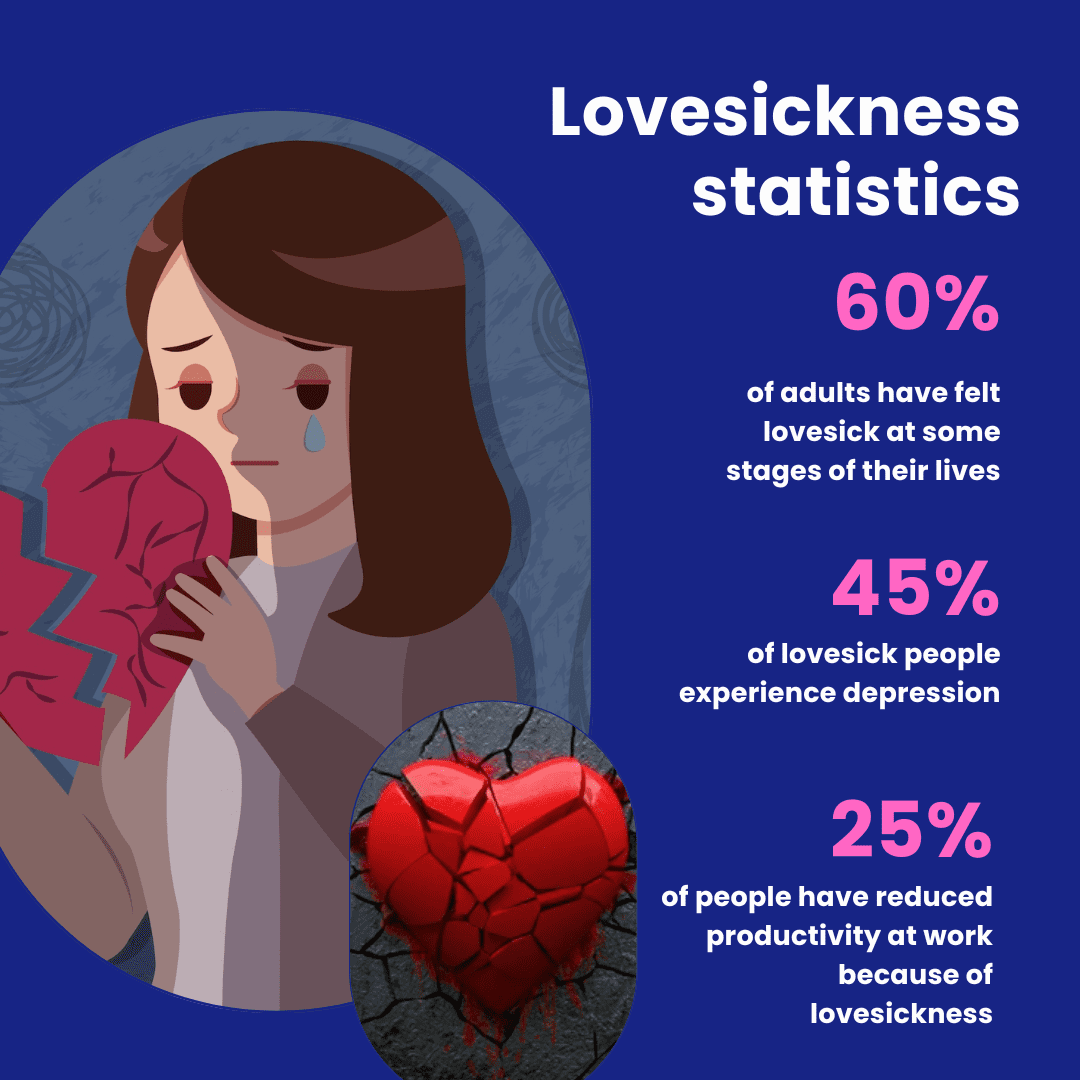
Is being lovesick a real thing? Yes, numerous people suffer from it. Just look at the statistics to see that it is a common emotional state that comes closely with loneliness, low self-esteem, and heartache.
- Based on the Journal of Psychology and Psychotherapy, more than 60% of adults have come through lovesickness at some point in their lives.
- The American Psychological Association states that such a mental condition can result in anxiety and depression in nearly 45% of people who experience it.
- Sleeplessness, appetite loss, and exhaustion are among the physical symptoms that 35 percent of lovesick individuals report, according to the National Institute of Mental Health.
- The International Journal of Workplace Health Management reports that when people constantly think about their private lives, it substantially reduces productivity. Up to 25%, to be precise.
While analyzing the real facts, it is obvious that the love sick meaning is directly connected to emotional and physical health, negatively affecting both. Moreover, such an unsettled and downcast disposition weakens all spheres of life.
Read also: Flirty Conversation Starters: Cool Ideas to Consider.
6 Main Lovesickness Symptoms
So, what are the symptoms of lovesick? There are some red flags that indicate a troubled emotional state related to constant thoughts dedicated to a person you are in love with. While they vary depending on the person, they might compromise the overall well-being, which doesn’t have anything in common with happiness and can lead to persistent distress. Keep track of these warning signs of lovesickness and take care of your mental health.
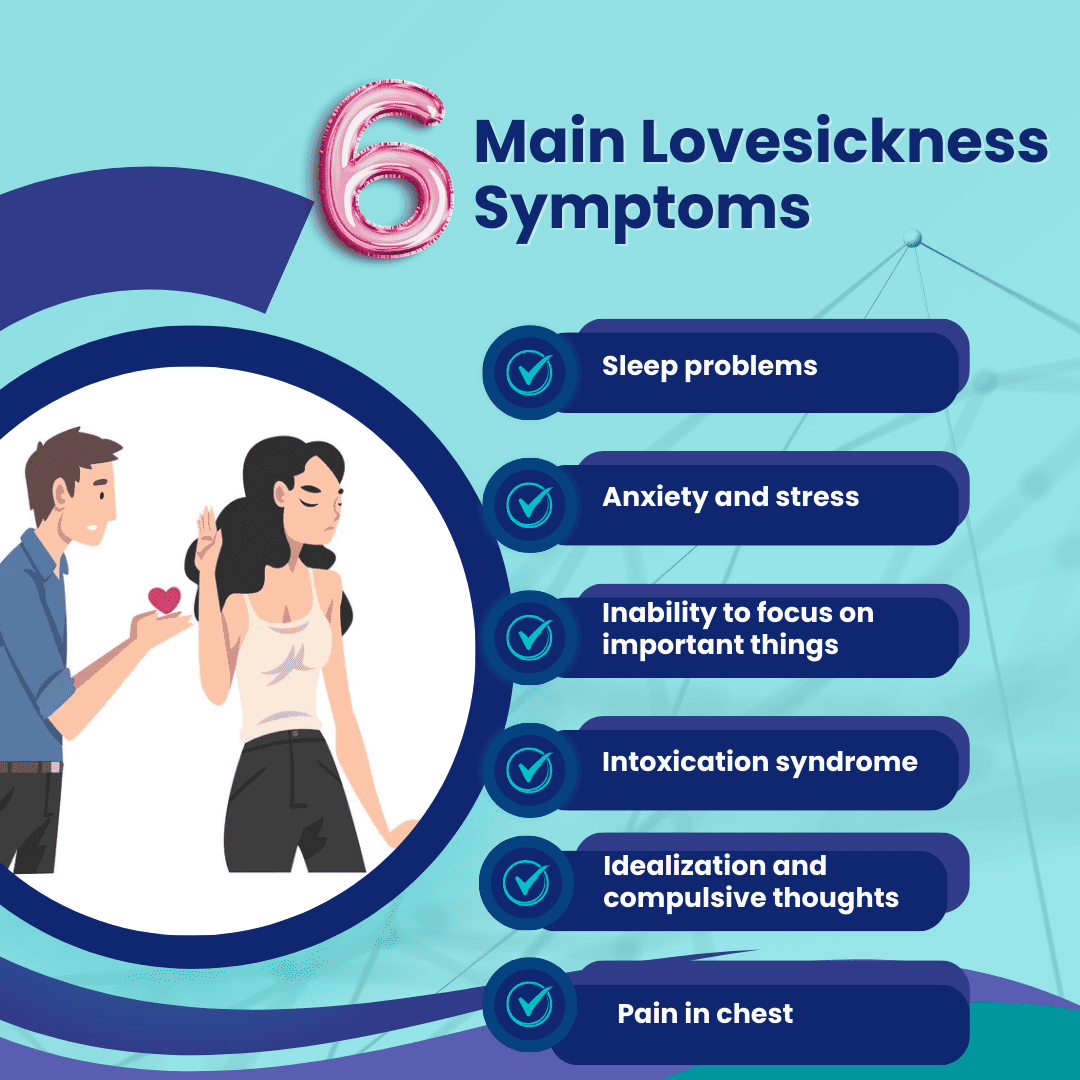
Sleep problems
The absence of your partner makes your nights sleepless. You are stuck with one person and can’t get rid of these thoughts at all. The statistics say that 35% of people experience racing thoughts at night while thinking about their significant others. Such conditions may put you on edge in the long run, affecting your everyday routine negatively in a very dramatic sense.
Anxiety and stress
A constant feeling of anxiety follows you, making you just crazy. You worry about how your partner is doing. If the anxiety accompanies the urge to stalk your significant other, this is a double check. You know, stress may be the root of other illnesses, both physical and mental. Even a tiny trigger may make you treat your hair out. It may be a serious obstacle to living a quality life.
Inability to focus on important things
Your health is important as well as your career, family, and social life. Being love sick means concentrating on a single person without noticing crucial events and people that surround you. Your partner or the breakup may be all that is on your mind, diverting your attention from the tasks at hand. After awakening from your lovesickness, you may notice that you didn’t achieve your career goals, narrowed down the circle of your acquaintances and friends, and felt aloof. That’s not good at all.
Read also: Christmas Gift Ideas for Women: Choose a Perfect Christmas Present.
Intoxication syndrome
Being lovesick means experiencing all those symptoms during the disease, just like intoxication. Dizziness, shakiness, nausea or stomach distress, increased tearfulness, fever, and even vomiting can accompany your depressed mood. Physical syndromes come from your mind and you can stop all those unpleasant symptoms by reducing stress from the constant thoughts about your partner or ex.
Idealization and compulsive thoughts
While you think that you are just in love with your partner, you may be already obsessed. You may start to romanticize the relationship or become fixated on its flaws. Clouded thinking and impaired judgment often result in the idealization of a person, which gives you an absolutely distorted sense of your love affairs. Aside from being a red flag of lovesickness, it may also be a sign of a toxic relationship when one partner gives everything and another doesn’t give anything in return.
Pain in chest
Therapists and psychologists often call it the syndrome of a broken heart. It is a severe condition where intense emotional stress leads to heart symptoms similar to a heart attack. A person may experience pain in the chest, a racing pulse, a pounding heart, and tension. In contrast to a heart attack, it typically results from a transient weakening of the heart muscle rather than clogged arteries. Nevertheless, it is alarming that a person may require professional therapy.
How to Cure Lovesickness? – Tips from a Dating Coach
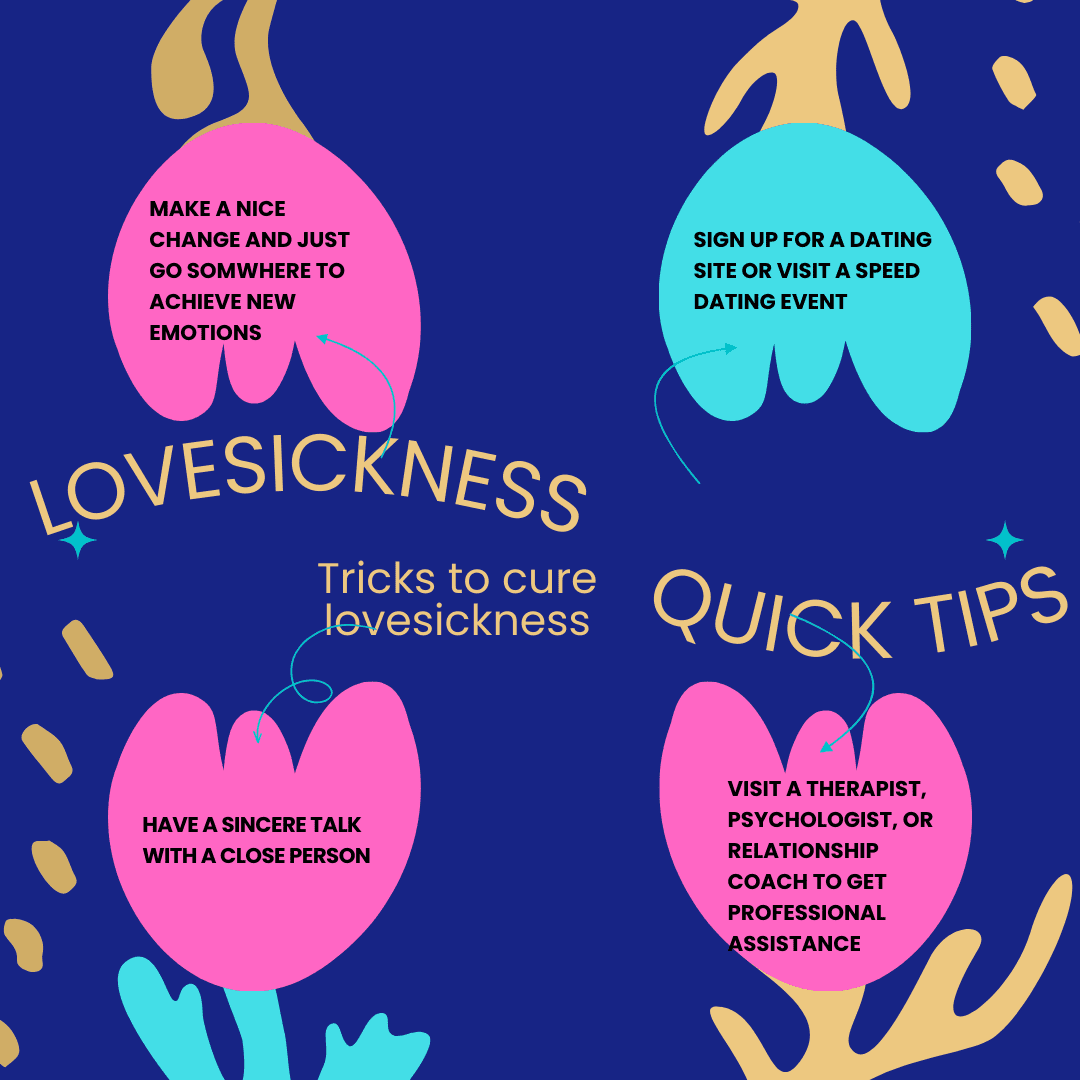
If you have already noticed one of the symptoms described above, you may ponder the question, “What to do when you’re lovesick?” Actually, you will need to fight this dependence on another person if you want to improve your state of mind, and emotional health and return the zest for life. Check out the effective tips from a dating coach to get rid of lovesickness and change your life for the better.
Start with self-care
Treat yourself with kindness and combine it with taking steps forward to overcome that toxic dependence on your partner. Invest in yourself, share your worries with close friends, and seek therapy if you are feeling stuck with intrusive thoughts. Who knows? Maybe it’s just time to broaden the circle of your acquaintances, take a deep dive into a new hobby, or attend new classes.
👉How long does lovesickness last? Actually, it depends only on you and your relationships. But there is no need to count the days when you feel better. All you can do is take care of yourself and jazz up your everyday routine with extraordinary activities and you will experience relief eventually.
Mark your own boundaries
Have you ever heard of those out-of-sight and out-of-mind things? This is your next step in treatment. Yes, it may be a real challenge, but you should stick to it. If you are engaged in drama, a toxic relationship, or a break-up, you will need to draw the line for yourself and limit all the interactions with your partner. This means unsubscribing them on social media, blocking their accounts, deleting photos and videos, and just keeping them away.
👉How do you feel after setting those healthy boundaries? Firstly, it will seem like hell, but then you will see that life is possible without stalking your partner or going in those obsessive circles.
Go in for sport
Even if you don’t strive to be a fitness model, you can do some sports to discover how to get over lovesickness. It really works. The key takeaway is that workouts — particularly cardiovascular exercise — can alter your brain chemistry and reduce the load of lovesickness. Aside from eliminating anxiety and getting rid of the feeling of being miserable, you will get fitter and more attractive. This may be the first step to embarking on a new life with new habits and maybe a new love.
👉How to make your workout even more enjoyable? Complement your exercises with upbeat music. You will definitely cheer yourself up by following the rhythm.
Organize a trip
There is no need to plan a trip abroad. All you need is to make a nice change and just go somewhere. It might even be the nearest city. A short break will help you to achieve new emotions and impressions which will cover the bitterness that lovesickness may bring to you. Visit new places, walk around the crowded streets, go for a city break, try new food — all of these will bring you some vibrant memories that will help you overcome your sadness.
👉Even though organizing a trip is a nice option to get away from it all, it works best with the methods described in this post, like a complex treatment. If the relief doesn’t kick in, you may need extra assistance, maybe even a professional one.
Seek new romantic adventures
This may be the perfect way to overcome both the emotional and physical symptoms of missing someone you love. Sign up for a dating site or visit a speed dating event. Once you chat and flirt with someone else, you will see that the world is full of romantic opportunities, and there is no reason to get stuck on one person. Each dating encounter may bring you a vibrant spectrum of emotions, which may serve as a pill for your love disease.
👉Choose only reliable dating platforms with a good reputation in order to have the best experience possible. Once you find a person of your interest, you will see that there is no need for lovesickness since the world offers a lot of candidates to fall in love with.

Share your emotions with close people
Sometimes, the best way to overcome the symptoms of lovesickness is to have a sincere talk with a close person. You just need to trust your friend or relative and share your sadness. After getting compassion and support, you will see that there are people in this world who really value you.
👉A friendly talk with someone you can rely on makes a big difference when it comes to getting relief from excessive emotions. The right words may turn your head in the right direction to move forward when it comes to love.
Address a specialist
Do you consider all those above-mentioned tips pointless when it comes to curing lovesickness? You can always visit a therapist, psychologist, or relationship coach to get professional assistance. A specialist will guide you through your array of emotions and help you see the light at the end of the tunnel. It is possible to solve all issues if you have a desire and a knowledgeable person by your side. Nevertheless, it is you and only you who can help you get better from lovesickness.
👉What to do when you’re lovesick? Visiting a specialist who can help you improve your mental state of affairs is a must nowadays. So, don’t be afraid to seek professional assistance to improve your quality of life.
Summing Up: Is Lovesickness Real?
Lovesickness is a real phenomenon, affecting both the human mind and body. It comes with a diversity of symptoms, such as anxiety, insomnia, loss of appetite, indifference to things that surround you, and even physical pain. A lot of studies and statistics prove that lovesickness isn’t just a poetic concept but a real condition negatively affecting numerous people worldwide. Understanding that lovesickness is a mental problem is critical to treating its symptoms with compassion and understanding. If you have ever noticed the signs of lovesickness, try the tips mentioned above to cure it. If nothing helps, contact a therapist and get professional assistance to change your life for the better.
If the content above helped clarify what truly matters in a partner, continue strengthening that clarity through the romantic compatibility blog. Each new publication deepens understanding of emotional alignment and shared direction. Consistent education sharpens standards. Strong standards protect your future. When you are ready to turn intention into action, explore profiles on the commitment-based dating website and begin your next chapter.
What Is the Psychological Nature and Existential Meaning of Love Sickness?
Love sickness is a complex psycho-emotional state resulting from the frustration of the need for intimacy with a specific object of attachment. From a clinical perspective, this condition is comparable to the grieving process, where the individual experiences the loss of not only a partner but also a part of their own identity that was integrated into the relationship. The existential meaning of this phenomenon lies in signaling a profound deficiency of emotional resources and the necessity of revising mechanisms of psychological autonomy. This longing acts as an indicator of a symbiotic bond, suggesting that the individual has delegated responsibility for their own well-being to another person, which leads to personal stagnation in the long term.
Rather than perceiving this state exclusively as destructive, it should be viewed as a catalyst for deep reflection and the search for new meanings. A period of intense longing allows the psyche to process accumulated experiences and integrate them into a renewed self-structure. This is a time of forced introspection, when external stimuli lose their significance, giving way to the analysis of internal conflicts and values. Thus, love sickness is a painful but necessary adaptive mechanism that, with the right approach, leads to increased emotional maturity and the attainment of genuine independence, making the individual capable of more conscious partner choices in the future.
Which Somatic and Cognitive Symptoms Are Characteristic of the Acute Period?
The clinical picture of love sickness includes a wide range of manifestations affecting both physiological and cognitive levels of functioning. The body reacts to emotional trauma with a sharp change in hormonal levels: an increase in cortisol and adrenaline against a sharp drop in dopamine and oxytocin leads to a state of permanent stress. This triggers sleep disturbances, loss of appetite or compulsive overeating, and chest pains known as "broken heart syndrome." The cognitive sphere during this period is characterized by a narrowing of consciousness, where all thought processes become fixated on the object of love. Typical symptoms of this condition include:
- intrusive memories and ruminations associated with past experiences;
- inability to concentrate on current professional and household tasks;
- sharp mood swings—ranging from deep apathy to fits of uncontrollable anger;
- social maladaptation and a drive toward total isolation;
- the emergence of a compulsive urge to monitor the social media of the attachment object.
Prolonged stay in a state of acute longing without proper correction leads to exhaustion of the nervous system and a decrease in immune status. Cognitive distortions arising during this period often force the idealization of the object of love, ignoring negative aspects of the relationship, which only intensifies the suffering. It is important to identify these markers in a timely manner, as they indicate the transition from ordinary sadness to a pathological form requiring professional intervention. Understanding the somatic nature of these symptoms helps the individual realize that their condition is driven by objective biological processes, which slightly reduces the level of subjective discomfort and self-blame.
What Are the Strategies for Psychological Correction and “Treatment” of This Condition?
Treating love sickness requires a comprehensive approach aimed at restoring the chemical balance of the brain and deconstructing painful cognitive schemas. The primary task is the complete cessation of contact with the object of attachment—a "zero interaction" strategy that allows for a reduction in the intensity of dopamine spikes associated with reminders of the person. This is akin to detoxification in addiction: the psyche needs time for the neural connections responsible for the specific attachment to begin weakening. In parallel, it is crucial to establish a physical activity regimen, as exercise promotes the natural production of endorphins, helping to neutralize symptoms of the depressive spectrum.
Psychotherapeutic work should focus on regaining control over one's own life and strengthening personal boundaries. Using cognitive-behavioral therapy techniques allows for the identification and challenging of irrational beliefs regarding the indispensability of the partner or one's own worthlessness without them. It is essential to gradually shift attention to spheres unrelated to romantic relationships: professional development, creativity, and social volunteering. Progressively filling life with new meanings and achievements contributes to the restoration of self-esteem and the formation of a new identity, where the "Self" is no longer defined by the presence or absence of another person. The process of "recovery" is not linear, but maintaining discipline in emotional hygiene inevitably leads to liberation from oppressive dependency.
What Role Do Social Support and Creative Sublimation Play in Rehabilitation?
The social environment acts as a vital stabilizing factor, providing the necessary level of external validation and support during a crisis. Communicating with close individuals capable of empathetic listening without judgment helps redistribute the emotional load and foster a sense of belonging to the human community. However, it is important to avoid excessive discussion of the breakup details to prevent fueling cyclical ruminations. Social integration should be directed toward collaborative constructive activities that return a sense of social competence and distract from internal distress. Group therapy is also effective, as it allows one to see the universality of suffering and receive support from people with similar experiences.
Creative sublimation represents one of the most powerful mechanisms for transforming pain into an aesthetically valuable product, which brings deep relief to the subject. Keeping a diary, engaging in painting, music, or literature allows for the objectification of one's feelings, moving them from the internal space to the external world. When longing is embodied in a concrete form, it ceases to be an all-consuming element and becomes an object that can be managed or studied. This not only reduces the intensity of the experience but also enriches the personality with a unique experience of self-expression, turning trauma into a source of inspiration. Rehabilitation through creativity allows a person not just to forget the pain but to give it meaning, integrating it into their personal history as a vital stage of becoming.
How Can Recurrences Be Prevented and Immunity to Destructive Attachment Formed?
The prevention of future states of love sickness lies in developing a high level of emotional intelligence and mindfulness in partner selection. A key factor is working on one's own self-sufficiency so that new relationships are built on the principle of "desire" rather than "need." It is necessary to learn to recognize early signs of codependent scenarios, such as the idealization of a partner, the abandonment of personal interests, or a drive for total control. Understanding that happiness is the result of internal work, rather than an external gift from another person, forms a reliable psychological immunity against destructive attachments.
The formation of healthy boundaries and the development of self-help skills allow an individual to remain resilient even in the event of a relationship's conclusion. The ability to experience solitude as quality time with oneself is a sign of mental health and a defense against the panicked search for a new object to fill the internal void. Regular mindfulness practice and monitoring of one's own emotional state help to notice alarming tendencies in time and correct them. Ultimately, love sickness that has been experienced and successfully overcome becomes a valuable resource that makes a person wiser, more empathetic, and capable of building truly deep, mature, and equal unions based on mutual respect and freedom.

Robert Smith is a professional writer and relationship expert who has devoted his life path to giving advice to those seeking love outside their countries. Robert was able to combine his two passions—his love of writing and his talent for international love affairs. The author has developed his dating strategies based on his investigations into the international dating niche and his own experience.