



These days, young people’s relationships frequently struggle with the issue of love bombing. According to Forbes, the hashtag #lovebombing has 329 million views on TikTok. Are you suffering from over-attention from your new partner? Our comprehensive guide aims to reveal all the signs, reasons, and ways to deal with love bombing.
Key takeaways:
- Love bombing is a psychological deviation in the behavior of a partner, which is not normal in healthy relationships. When they give you too much attention and love and declare their feelings from the first days of the meeting, you are faced with a love bombing.
- There are three phases of love bombing in love affairs that you need to be aware of. The first is the Idealization phase, the second is the Devaluation phase, and the last is the Discard phase. Each of them has its own signs and reasons.
- To save and maintain a couple from overwhelming affection, it is necessary to acknowledge the problem first. There are key signs to look out for if you have doubts about your partner. Next, be prepared to take action to improve the situation.
🧐 Love Bombing Meaning
To define love bombing, it is correct to say that it refers to some kind of manipulation people use to satisfy their needs. From the very beginning of the relationship, you may get unexpected love declarations, romantic surprises, tender gestures, and pleasant signs of attention. “Love bombing then silent treatment” is the base of this abuse trick. As a result, one of the partners begins to feel over the top of such affection and falls into the trap of toxic bonds.
There are some reasons why people love bombing. One of them is narcissistic personality disorder. Individuals who have the problem may demand a lot of attention and admiration and have difficulty showing empathy. Such behavior may be the result of their childhood traumas.
What is love bombing in detail? Most often, it is an unconscious behavior of people. That is, some people are really into their relationships, but as they get used to comfort and feel secure, their behavior switches from normal to narcissistic.
🔊 Love bombers tend to rush things. They make you feel like you’ve found your soulmate. They create the illusion of a perfect romantic engagement and make great plans to keep you in their ideal vision of affairs. You like it and they know it. Things develop gradually and they have certain tactics. There are three main phases of love bombing that you should exactly learn to recognize such an affair. 👇🏻
1️⃣ Idealization phase
It usually refers to the beginning of a romantic interaction. The love bomber starts doing everything to gain your trust. They try to get your attention, evoke positive emotions, and let your guard down. You may feel like you have met the perfect partner who makes you happy. They show their feelings too often, praising you, giving you unnecessary gifts, and promising things that they won’t fulfill in the future.
2️⃣ Devaluation phase
Just when you feel comfortable in a relationship, you may notice warning signs soon. Your partner may start to control you in different ways. They may become more demanding of your time and get annoyed when you make plans without their presence. Love bombers also think it’s okay when they restrict you from spending time with friends and relatives. In the worst situations, these people might use violence and manipulation to persuade you to do what they want.
3️⃣ Discard phase
When you notice things aren’t going right, you will try to improve relationships, for example, through healthy conversations. But love bombers will do their best to avoid any discussions and compromises. Most likely, they will not agree with your complaints but instead end the romantic connection. This can make you feel confused, disoriented, or guilty.
Read also: How to Describe Yourself on a Dating Website?.
If you’re experiencing a love bombing, it’s important to be honest with yourself about the situation. This behavior rarely improves on its own, and enabling it can result in devastating consequences for your well-being. Remember, it’s not your job to “save” the love bombers, and you cannot change this behavior without their desire.
💡 Main Signs to Identify Love Bombing
It is important to distinguish between abuse and healthy signs of attention. Pay attention to these signs of love bombing in a relationship to recognize manipulation.
Read also: Where to Get a Mail Order Bride? – All the Secrets Revealed.
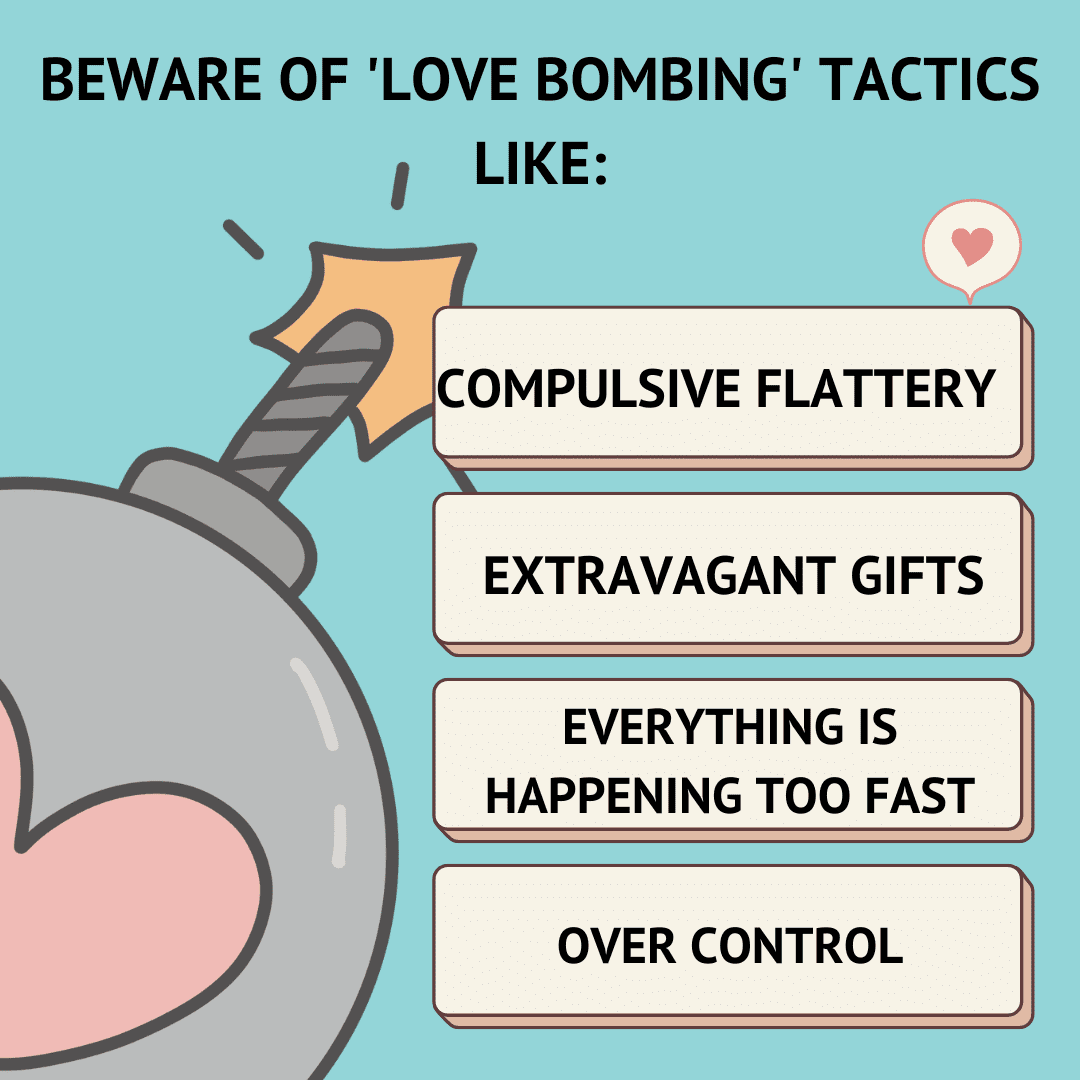
🚩 Compulsive flattery
It’s okay to give and receive compliments when you are engaged in romance. But sometimes it becomes too much. Be careful of people who are too obvious about praising and idealizing you.
There are some love bombing phrases like: “I’ve never met anyone more beautiful than you,” “My life became perfect after you came along,” “We were made for each other,” and “You’re my soulmate.” It is normal to hear such words from the partner after some time of being in a relationship, but not during the first days of your interaction. It is one of the red flags of unhealthy infatuation.
🚩 Extravagant gifts
One of the love bombing examples is giving expensive gifts to show their generosity and attention. At first, such a partner seems perfect, but you need to be careful. A person may give you presents not only to please you but also to make you feel obliged to stay in touch with them. Later, the manipulator may blame you for not appreciating their gifts or demand more gratitude.
🚩 The fast development of the relationship
If you quickly become comfortable with someone, that’s a good thing. On the other hand, even though you recently met, declarations of love, offers to move in together, and marriage are red flags. The person is trying to influence you as quickly as possible by doing this.
🚩 Excessive control
When manipulative romantics understand you are comfortable with them, they can demand a lot of attention. Saying, “I want to be next to you always,” or making an hourly phone call are just two examples. They explain this away as excitement or worry. This is how your personal boundaries are gradually erased.
It is also worth asking yourself: “Am I love bombing?” If you have noticed the below-described signs in your behavior, it is recommended that you look for help from psychologists.

👫 Can Relationship Survive after Love Bombing?
Yes, it can be possible if you have a great desire to be with the person you consider a worthy partner for you. There are some solutions to overcome emotional manipulation and vain love expressions.
- Set boundaries. If you suspect that you are facing love bombing, try to set boundaries at the beginning. For example, you can say that the relationship is moving too fast and you don’t feel comfortable with it. It is advisable to refuse some unnecessary gifts or limit the time you spend with your partner. It will help slow things down and see if they have heard your request. If your words have been ignored, it’s best to break up.
- Find support. You can ask someone for help. For example, talk to a friend or close person. This will help you get a fresh perspective on your partner and realize the kind of person you are interacting with.
🗝 Summing – up
Love bombing is the compulsive behavior of a person in a relationship with the goal of manipulating. It can be caused by mental disorders and, more specifically, narcissistic tendencies. Depending on how you feel about your partner, you may be able to treat your bonds or go separate ways. Hopefully, the recommendations below will help you.
Did this article provide grounded insight into lasting partnership? Subscribe to updates in the serious partnership blog for new posts about loyalty, discipline, and emotional maturity. Fresh content helps refine relationship strategy. Strategy creates better outcomes. When you are ready to act, begin on the platform designed for lasting relationships and start building something stable.
The Phenomenology of “Love Bombing” in the Context of Modern Psychology
In 2026, the term "love bombing" has firmly established itself within the category of destructive behavioral patterns, characterized by an excessive display of attention, admiration, and affection at the very beginning of a relationship. The expectation that a rapid development of romance is a sign of "true love" often proves to be a cognitive distortion of the subject who falls into the manipulator's trap. Analysis shows that the primary goal of such a strategy is the swift establishment of control over the partner's emotional state and the creation of an artificial dependency. Unlike healthy infatuation, where closeness occurs gradually, bombing is aimed at breaching personal boundaries and creating a vacuum in which the manipulator becomes the sole source of validation and happiness for the victim.
The psychological mechanism of this phenomenon is based on the hyperstimulation of the subject's dopamine system. The expectation of constant approval and ecstatic messages forms a biochemical attachment similar to a narcotic addiction. The Victoriyaclub Laboratory notes that in 2026, against the backdrop of widespread digital depression and loneliness, individuals have become particularly vulnerable to such tactics, perceiving aggressive adoration as a long-awaited salvation. However, the stage of idealization is inevitably followed by a stage of devaluation, where the manipulator abruptly changes tactics, causing a profound crisis of self-esteem in the partner. Understanding that "love bombing" is not a manifestation of feelings but a tool of dominance is the first step toward preserving the subject's mental health in the conditions of modern dating.
Identification of Manipulation: An Analytical List of Warning Signals
To distinguish sincere interest from destructive manipulation, one must analyze not only the content of the partner's actions but also their intensity and timing. The expectation of a catch might seem paranoid, but in 2026, Victoriyaclub analytics confirm that conscious caution is a form of emotional hygiene. A manipulator always strives to shorten the distance before the subject has time to conduct a rational assessment of their personality. This manifests as an obsessive desire to spend every minute together and to build grandiose plans for the future after only a few meetings.
To systematize the signs of "love bombing," the Victoriyaclub Laboratory identifies the following list of markers:
- Intense Flattery and Adoration: The partner showers the subject with compliments that seem excessive for the current duration of the acquaintance;
- Mirroring of Interests: The manipulator suddenly discovers a complete identity of tastes, hobbies, and life goals, creating the illusion of a "soulmate";
- Excessive Digital Activity: Endless calls and messages that demand an immediate reaction and leave the subject with no personal space;
- Rapid Future Planning: Discussion of marriage, cohabitation, or children within the first weeks of communication;
- Extravagant Gifts and Gestures: Using material resources to create a sense of obligation or dependency in the partner;
- Isolation from the Social Circle: A soft but persistent suggestion that the subject's friends and family "do not understand" them or hinder true happiness;
- Violation of Physical Boundaries: Ignoring requests to slow the pace of intimacy or the need for solitude;
- Demonstrative Vulnerability: Early confession of traumas or secrets intended to evoke a reciprocal trust and a desire in the subject to "save" the partner.
This list allows the subject to perform an inventory of the relationship at an early stage. The expectation that the manipulator will "change" if they are sincerely loved is a dangerous misconception. The Victoriyaclub Laboratory emphasizes that "love bombing" is often a prelude to harsher forms of abuse, including gaslighting and financial control. In 2026, critical thinking becomes the primary defensive mechanism; if the development of events seems "too good to be true," the subject must slow the process and reconnect with their internal sensations. The ability to recognize these signals allows one to avoid the prolonged emotional rehabilitation that inevitably follows the breakdown of a relationship built on manipulation.
Defense Mechanisms and Strategies for Fighting Emotional Aggression
When a subject realizes they are in the epicenter of "love bombing," the key task becomes the restoration of personal boundaries without a sharp escalation of conflict. The expectation that a direct conversation about manipulation will lead to understanding from the partner often goes unfulfilled, as manipulators are prone to defensive aggression or accusations of "ingratitude." Analysis shows that the most effective strategy is the "grey rock" method or a gradual increase in distance. The subject needs to become less emotionally reactive, ceasing to feed the manipulator's narcissistic resource with vivid reactions—both positive and negative.
A vital aspect of the struggle is returning to one's real social circle. The expectation of support only from the partner is precisely the state the manipulator aims to achieve. The Victoriyaclub Laboratory recommends actively restoring ties with friends and family who can provide an objective external assessment of what is happening. In 2026, the psychological resilience of the subject depends on their ability to diversify sources of support. If attempts to slow down the relationship evoke anger, resentment, or guilt-tripping from the partner, this serves as definitive confirmation of the manipulative nature of the bond. In such cases, the only safe exit is the complete cessation of contact (the "no contact" method), as any attempt to "explain oneself" will be used for a new cycle of bombing.
Long-term Consequences and Recovery After a Manipulative Connection
Exiting a relationship that began with "love bombing" is often accompanied by a state similar to withdrawal syndrome. The expectation that the subject can instantly forget a "wonderful" partner ignores the physiological reality of the dopamine crash. Victoriyaclub analytics indicate that in 2026, the recovery process requires a comprehensive approach, including both cognitive therapy and somatic work. Manipulation leaves a deep mark in the form of distrust in one's own feelings and fear of new acquaintances, requiring time to integrate the experience and restore a basic sense of safety.
The expectation of rapid healing can lead to a relapse—returning to the manipulator during their first attempt to "apologize" (so-called "hoovering"). It is crucial for the subject to realize that the ideal image created at the beginning never existed in reality; it was a carefully constructed facade. The Victoriyaclub Laboratory notes that true recovery occurs when the subject stops looking for the reasons for the manipulator's behavior within themselves and shifts the focus back to their own development. In 2026, the experience of surviving "love bombing" can become a catalyst for the growth of emotional intelligence, allowing one to build future relationships based on gradual trust, mutual respect, and the preservation of each partner's individuality.
Final Conclusion: Awareness as the Foundation of Healthy Intimacy
In concluding the analysis of the "love bombing" phenomenon, it can be stated that in 2026, the ability to distinguish passion from control is a vital survival skill in society. The expectation that love must be a "hurricane" or a "spark" is a myth actively supported by mass culture but has little in common with healthy attachment. Victoriyaclub analytics emphasize that true intimacy grows in silence and respect for the other person's pace. A subject possessing high self-esteem does not require excessive flattery and is capable of timely recognizing an attempt to capture their will under the mask of adoration.
Thus, knowledge of the signs of manipulation transforms the subject from a potential victim into a conscious player in the field of interpersonal relationships. The expectation of a result in the form of deep and honest feelings requires patience and a rejection of quick emotional substitutes. In 2026, we are learning to value consistency and predictability in a partner more than theatrical gestures and vows of eternal love on a second date. Let your understanding of the mechanisms of "love bombing" become a reliable shield behind which you can build a truly strong and harmonious union where there is no place for manipulation, but space for genuine human warmth and freedom.