



Ukraine women could teach you how to tie a tie or could tie a tie for you on a daily basis if you marry her. Slavic beauties enjoy those men who wear ties. Tying a tie is a science in the world of fashion. Today there exist about 30 most popular necktie knots. Every self-respecting man and a stylish woman must know how to tie a tie and distinguish between the manners of tying.
A Few Facts on How to Tie a Tie for a Tall Man / Short Man
Not a secret that Russian and Ukraine women know how to take care of their men. Every Ukrainian woman knows that a business suit makes a man more attractive. Women learn special schemes and instructions on how to tie a tie to their beloved husbands. As you may know, the tie should always be tied on the shirt, and not in the hands. It should not be too long or too short. The knot should be made freely without dragging the tissue.
Is it sad for a man not to know how to tie a tie? No, if he has an experienced and caring woman by his side. In Ukraine, women tend to tie the following types of knotted ties: four-in-hand knots, small knots, and Christensen knots.
Four-in-hand knot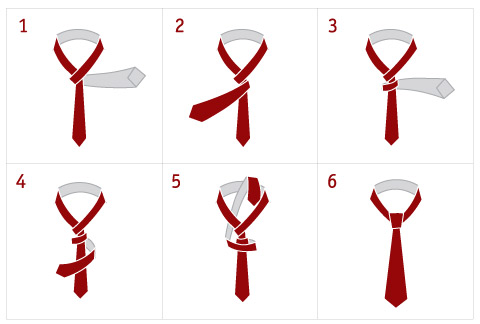
This is a universal knot that could be used on any tie and goes well with any type of collar. Cross the ends and get the wide end under the narrow. Pull through the neck loop. Holding the knot, pass the wide end in the eye formed. Flatten and tighten the knot.
Read also: How to Deal with Someone Who Is Hot and Cold.
Small knot
A small knot is suitable for ties made from heavy fabrics: wool, or cashmere jacquard. It will look good with a tight-fitting collar. Put on a tie the wrong side down. Get into the wide end over the narrow and pull it through the neck loop. Pass the wide end formed in the eye.
Christensen knot
It is one of the most elegant knots. It is ideal for special occasions and business dinners. Put the tie wrong side down to the neck and cross the ends. Get a wide end under the narrow. Put a wide end over the neck loop. Pass it through the neck loop from the top down. Put a wide end to the other side over the knot. Pull it through the neck loop. Pass it into the eye of a knot.
The Last Word
All in all, you can practice how to tie a tie on your own or ask your lady to help. Ukrainian women know all the secrets of excellent men’s looks and appearance. So, feel free to ask for help whenever it is necessary. There is no doubt, that your significant other will do her best on how to tie a tie.
If the insights above gave you practical direction, more structured guidance is available inside the long-term relationship articles section. There you will find deeper breakdowns of trust, emotional maturity, and partnership dynamics. Consistent reading builds clarity and confidence. Knowledge prepares you for real choices. And when preparation turns into readiness, you can register on the marriage-oriented dating service and begin meeting women who value commitment and family.
Accessory Selection Analysis and Preparation for Knotting
Choosing a necktie is a fundamental step in shaping a professional image, requiring consideration of fabric texture, collar width, and overall suit style. Silk products are considered the classic standard, providing smooth gliding and the formation of an aesthetic dimple, while wool or linen options are suitable for less formal occasions. Before starting the process, it is essential to ensure that the length of the accessory corresponds to the man's height, as the tip of the tied product should reach the trouser belt buckle. Preparation includes raising the shirt collar and fastening the top button, which provides a rigid base for the future knot and prevents its deformation during wear.
The correct positioning of the wide and narrow ends on the chest determines symmetry and final length. The wide end is usually placed about 30 centimeters lower than the narrow one, creating the necessary fabric margin for forming turns. It is important to ensure that the seams are on the inside, preventing twisting of the material. Quality preparation minimizes the number of adjustments during the tying process, allowing for a flawless appearance on the first attempt. Attention to detail at this stage guarantees a comfortable fit around the neck throughout the entire workday.
Technique for Forming the Classic Four-in-Hand Knot
The Four-in-Hand knot is recognized as the most universal and simple method, suitable for most collar types and materials. Its popularity stems from a slight asymmetry that gives the look naturalness and dynamism. The formation process begins by crossing the ends, where the wide end is laid over the narrow one. This is followed by a series of sequential actions that ensure a secure structural fixation:
- the wide end is passed under the narrow one horizontally from right to left;
- a turn is made over the narrow part to create the front side of the loop;
- the fabric is passed through the neck loop from bottom to top on the inside;
- the end is tucked into the "ear" formed at the front;
- the knot is carefully tightened while simultaneously holding the narrow part of the tie.
The final touch involves centering the knot relative to the collar and checking the tension. It is important to avoid excessive squeezing of the fabric to preserve the volume and texture of the accessory. The Four-in-Hand pairs perfectly with button-down collars and narrow spreads, making it the optimal choice for daily use in an office environment. The conciseness of this technique allows even those who rarely resort to formal attire to quickly master the art of wearing a tie.
Features of Creating the Voluminous Windsor Knot
The Windsor knot is distinguished by pronounced symmetry and significant volume, making it the ideal complement to shirts with a wide-spread collar. Due to the double wrapping of fabric, this method requires the use of ties made from thin materials or products of increased length. Formation begins with a standard crossing, after which the wide end is passed through the neck loop twice from different sides. This creates a triangular base that serves as a frame for the front part of the knot. The high density of the construction guarantees shape retention even during active movement, which is valued at ceremonial events and official receptions.
The technical complexity of the Windsor is compensated by its prestigious appearance. The knot must completely fill the space between the collar ends, leaving no visible gaps. When tightening, it is necessary to ensure that the triangle remains isosceles and the central dimple, if provided by the design, is positioned strictly in the middle. This accessory element visually broadens the shoulder line and accentuates the face, which is why it is often recommended for men with rectangular face types. A correctly executed Windsor symbolizes professionalism and strict adherence to the canons of classic male fashion.
Length Adjustment and Ensuring Proper Fit
Achieving the ideal tie fit requires not only knowledge of knots but also an understanding of anthropometric proportions. A critical parameter is the point of contact between the tie tip and the waistline: an accessory that is too short looks comical, while an excessively long one disrupts the vertical lines of the silhouette. The narrow end of the product should be completely hidden behind the wide one, for which a special keeper loop is provided on the back of high-quality ties. The use of a tie clip also helps fix the position, preventing the fabric from shifting when leaning or walking. The clip is traditionally located between the third and fourth buttons of the shirt.
The tightness of the knot against the collar should provide comfort without restricting breathing but without allowing sagging. If the collar stand is visible between the knot and the top button, it is considered a sign of untidiness. Adjustment is carried out by holding the narrow end and smoothly moving the knot upward toward the neck. A proper fit also implies the absence of distortion in the shirt's shoulder seams under the influence of tie tension. Harmony between all elements of the suit is achieved through multiple checks in the mirror, allowing for the timely correction of possible tying defects and the attainment of a flawless professional image.
Tie Care and Storage Rules
The longevity of a tie and the preservation of its presentable appearance directly depend on the culture of handling the accessory after wear. It is strictly not recommended to leave the knot tied for a long time, as this leads to irreversible deformation of the fabric fibers and the appearance of deep creases. The untying process should be the reverse of the tying process: one cannot simply pull the narrow end through the loop. Careful loosening of the knot allows the silk threads to return to their original state. After removal, the tie requires rest for at least twenty-four hours before the next use.
Storage is carried out in two main ways: suspended on special hangers or rolled up in individual compartments. Hanging is optimal for most fabrics, as the tie straightens naturally under its own weight. Rolling into a cylinder is used for knitted or jersey models to avoid stretching them. In case of contamination, professional dry cleaning is recommended, as home washing or incorrect ironing can irrevocably ruin the internal lining responsible for the knot's shape. Careful maintenance turns a high-quality tie into a long-term investment in a man's wardrobe.

Robert Smith is a professional writer and relationship expert who has devoted his life path to giving advice to those seeking love outside their countries. Robert was able to combine his two passions—his love of writing and his talent for international love affairs. The author has developed his dating strategies based on his investigations into the international dating niche and his own experience.