



Ghosting is the name of one of the most popular forms of abuse. It is associated with the disappearance of your partner from your life. While this person lives for their pleasure, you are on an emotional swing, trying to understand what caused this silence from the beloved one.
🤔 What does getting ghosted mean? Ghosting takes its name from the word ghost and refers to a style of communication when your partner simply withdraws into the fog and stops communicating. You don’t even have to try to write or call them in this situation; it’s easier to understand that there will be no communication with your other half, at least shortly.
Ghosting occurs in all types of relationships, but it is most noticeable in romantic relationships. After all, constant (or at least regular) communication is necessary here. A person who considers ghosting to be the norm may disappear from the radar in the middle of a discussion, arrange a meeting, not show up, or turn off the phone. And then the partner will appear in your life again and will find hundreds of excuses for such cold behavior on their part. Why do I keep getting ghosted? Perhaps you are too in love or attached to your partner, and it is difficult for you to change anything.
If your beloved suddenly disappears without saying anything, it’s just rude. But ghosting isn’t just about funny tricks. The most unpleasant thing is that the ghost appears again, then disappears again, then appears again – and so on ad infinitum. I will tell you about all the signs that you are in a relationship with a ghoster, and also determine the actions that you need to take in this case.
❓ How Do You Know If You Have Been Ghosted?
The main feature of ghosters is that they fear emotional intimacy with their partner. As a rule, this happens if they are ignored or criticized by their parents as a child. Such people are often independent, self-confident, and self-reliant. If these qualities help them in work, then in personal life they block the very possibility of emotional closeness. Ghosters often appear cold and unfeeling, which makes partners doubt the authenticity of their feelings. The main signs that you have been ghosted are here.
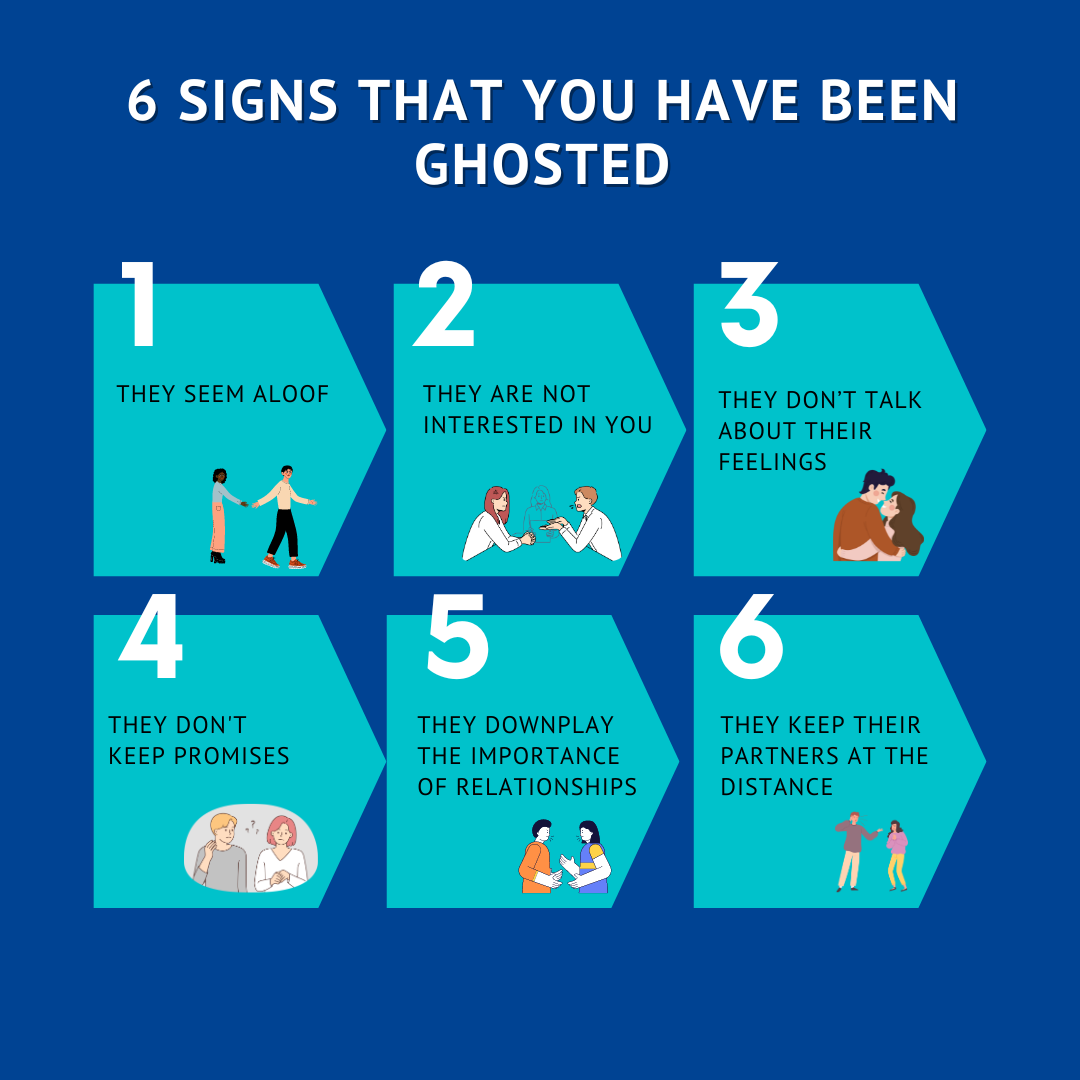
🙅🏻♂️ They seem aloof
When you show feelings and want to get closer, the ghoster can give a harsh rebuff, for example:
- ignore any such attempts from you;
- being disappointed in a relationship for no apparent reason;
- reproach you for being too intrusive;
- throw themselves into their work or hobby, when you offer to spend time together.
Read also: Dating Etiquette: Facts that You Might Not Have Known.
🙅🏻♂️ They are not interested in you
If your partner doesn’t call you when they go on a business trip, doesn’t find time during the day to call you and say “good morning” or “good night,” or to inquire about your well-being when you said you weren’t feeling well, don’t justify their ghosting by being busy. A loving partner, even when they are busy, never forgets to call their soulmate.
🙅🏻♂️ Partner doesn’t talk about their feelings
Your soulmate does not answer your confessions with anything intelligible, laughs them off, moves the conversation to another topic, and refuses to discuss joint plans. Even if they say that you are not indifferent to them, they behave coolly and distantly, clearly demonstrating that the words are not supported by real feelings.
🙅🏻♂️ They don’t keep promises
If they promised to do something for you and didn’t do it, then it doesn’t matter to them. This is one of the signs of ghosting. You should not justify this deception and believe that they are busy, have forgotten, or do not have the opportunity. If your significant other regularly forgets about you or disappears from your life, you are dealing with a ghoster.
🙅🏻♂️ They downplay the importance of relationships
The fear of becoming attached to a person and losing their own “I” is so strong among ghosters that they try to keep their partner at a distance and not disrupt the usual flow of life. Because of this, they do not post joint photos with their lovers and ask them to refuse such publications as well.
🙅🏻♂️ They keep their partners at a distance
Their plans come first for ghosters, so they would rather cancel a date than reschedule a meeting with a friend. All this may be accompanied by regular criticism of the partner and a reluctance to spend more time with them. They respond to specific reproaches with abstract reasoning, ignore their partner’s experiences, and never admit what exactly makes them behave this way.
Read also: What is Attachment and How it Can Affect Your Relationship?.
⚡️ How to Get Over Getting Ghosted?
Why do I keep getting ghosted? The situation is always painful for those with whom communication has suddenly stopped. Firstly, a person begins to look for reasons in themselves with guesses and assumptions about the reason for saying goodbye from the partner’s side. As a rule, people in this situation lose self-confidence and begin to be haunted by a feeling of guilt for having destroyed the relationship. This is not normal at all, I prepared top tips for you that will help you cope if you become a victim of ghosting.
1️⃣ Allow yourself to be sad
How to deal with getting ghosted? Give yourself some time before doing anything. Feeling hurt, confused, or angry when you’re ignored is natural. Think about your feelings, and try to understand your own emotions to take control of them.
2️⃣ Let them go
Refusal to answer is also a form of answer. The person decided to respond in silence and make it clear that she was no longer interested in communicating with you. They are simply afraid to say openly that they cannot or do not want to continue the relationship, much less explain the reasons for their behavior.
3️⃣ Challenge negative thoughts
Under no circumstances, blame yourself for what happened. Remind yourself that ghosting is primarily a reflection of the behavior and choices of another person, irresponsible and cowardly. Is it worth thinking about and worrying about them?
4️⃣ Avoid over-analysis
In this situation, analysis is impossible because the choice was made by one party without the participation of the other. This means that a person thinks only about themselves, and this is unlikely to change. Do you need such a partner? Get it out of your head and continue to live as before.
5️⃣ Trust, but verify
Intuition is a very strong feeling and needs to be trusted. If you understand that your partner is behaving strangely at the initial stage of communication/relationship, do not justify their behavior, take a closer look, and conclude. Choosing a reliable partner is important to avoid the problem of getting ghosted in a relationship. For example, pay attention to singles in Ukraine when you make your decision to date a lady. They know how to truly love and will never show a cold attitude to you.
6️⃣ Prioritize self-care
Engage in activities that bring you joy and relaxation, play sports, and go for a walk. In the movie Miss Congeniality 2: Beautiful and Dangerous, Gracie Hart (Sandra Bullock) said that people love those who love themselves. So do everything for yourself.
🔎 Summing up
As soon as you see one or a few signs that you are in a relationship with a ghoster, you must immediately react to them correctly. The tips above will help you cope with this difficult situation and save yourself and maybe your relationship. Remember that victoriyaclub.com is full of beautiful Ukrainian women as well as ladies of other nationalities who are looking for true love. I am sure you will meet a wonderful Ukrainian single woman or lady from other countries in a short period there.
Was the material above helpful and practical, not just theory? Subscribe to new posts in the blog about serious relationships to keep receiving clear guidance on trust, boundaries, and long-term goals. Regular updates help build a stable mindset for commitment. Strong choices start with strong understanding. When you decide to take the next step, explore real profiles on meet real women for marriage and begin building something serious.
What does being ignored mean in the context of modern relationship psychology?
Being ignored, often defined as "social exclusion" or "the silent treatment," is a form of psychological impact where one subject intentionally ceases communication with another. In 2026, this phenomenon has acquired new forms in the digital environment, such as ghosting or the deliberate lack of reaction to messages despite being active online. From a neurobiological perspective, the brain perceives being ignored similarly to physical pain, activating the same areas of the cerebral cortex. This makes silence one of the most powerful tools of passive aggression, aimed at undermining self-esteem and destabilizing the partner's emotional state.
The primary function of ignoring is to establish control and dominance by creating an informational and emotional void. The subject using this method deprives the other party of the opportunity for constructive dialogue, forcing them to plunge into self-reflection and a search for guilt. Unlike the healthy need for solitude, being ignored is characterized by a lack of explanation for the reasons and the absence of clear timelines for the end of the communicative pause. This creates a state of uncertainty that exhausts the victim's psyche, making them feel socially invisible and inadequate, which in the long term leads to the development of anxiety disorders.
What key signs indicate that the ignoring is intentional?
Identifying conscious ignoring requires separating accidental factors from a systematic behavioral model. In the information-overloaded environment of 2026, it is vital to distinguish between ordinary busyness and purposeful distancing used as a means of manipulation.
To identify a destructive pattern, one should pay attention to the following list of signs:
- Selectivity of responses: the subject reacts to messages in group chats or on social media but demonstratively ignores direct inquiries;
- "Digital presence" without contact: regular updates of content and viewing others' stories while completely failing to respond to personal notifications;
- Monosyllabic contact: if communication does occur, it is reduced to formal answers that exclude emotional involvement;
- Using silence as punishment: the cessation of communication happens immediately after a conflict or in response to a request to discuss an important topic;
- Abrupt change in patterns: a sharp shift in the frequency of communication without objective external reasons (such as work or health issues).
The combination of these signs indicates that silence is a tool of pressure. In 2026, psychologists emphasize that it is precisely the secrecy and the refusal to provide explanations that transform a communicative pause into an act of aggression. If a partner consciously sees messages but chooses not to respond over a long period while maintaining activity in other digital spheres, they are transmitting a message about the loss of the interlocutor's value. This behavior is often aimed at forcing the victim to be the first to seek reconciliation on the aggressor's terms.
How does being ignored affect the victim’s self-esteem and cognitive functions?
Prolonged ignoring triggers a process of psychological degradation based on the mechanism of "social death." The victim begins to doubt the reality of their perceptions and the adequacy of their actions, which can lead to a state close to the consequences of gaslighting. The lack of feedback deprives the person of the opportunity to correct their behavior, causing cognitive dissonance. Constantly replaying possible scenarios of guilt ("What did I do wrong?") overloads working memory and reduces concentration on professional and everyday tasks, which negatively impacts overall productivity.
At the level of self-esteem, being ignored provokes the development of feelings of inadequacy and inferiority. The subject begins to perceive themselves as an object unworthy of even negative attention, which is far more destructive than direct criticism. In 2026, therapists note that victims of chronic ignoring often lose initiative and become more prone to compliance in other areas of life. The destruction of the internal sense of security leads the person to seek confirmation of their significance from random external sources, making them vulnerable to further manipulation by those around them.
What are the most effective psychological strategies for dealing with being ignored?
The first and most important step in overcoming the consequences of being ignored is the refusal to force communication. In 2026, experts recommend a "mirror response" strategy combined with a total shift of attention to one's own resources. Obsessive attempts to "reach" the ignoring subject only strengthen their sense of control and righteousness. Instead, it is necessary to establish a timeframe: if no response is received after one or two polite inquiries, one should completely cease the initiative and take a position of observation, maintaining their own dignity.
The second stage involves working on internal resilience. It is necessary to verbalize what is happening to oneself ("I am being ignored, and this is the choice of the other person, not a characteristic of my personality"). It is important to realize that the partner's silence is their way of dealing with emotions or manipulating, and you are not responsible for their communication methods. In 2026, psychologists advise practicing "radical acceptance": agreeing that dialogue is currently impossible and directing the freed energy toward physical activity, hobbies, or communicating with those ready for full interaction.
How to prevent the repetition of the ignoring scenario in future relationships?
Prevention of such situations is built on the early identification of a partner's destructive tendencies and the establishment of clear communication boundaries. In the early stages of an acquaintance, one should pay attention to how the person reacts to disagreements: whether they are prone to dialogue or retreat into "deep defense." In 2026, maturity in relationships is defined by the partners' ability to verbalize the need for a pause ("I need time to cool down; I will write to you in two hours"), which is a healthy alternative to a sudden disappearance.
To minimize the risks of repeatedly encountering ignoring, it is recommended to adhere to the following principles:
- Developing one's own emotional autonomy, where your well-being does not depend 100% on the speed of a partner's responses;
- Openly discussing formats of digital communication and acceptable pauses in correspondence during the early stages of the union;
- Readiness to terminate relationships where ignoring is used as a regular method of pressure;
- Investing in a wide circle of social connections, which prevents fixation on a single object;
- Working on self-confidence, allowing one to perceive another's silence as a problem of the speaker, not the listener.
The ultimate goal is to surround oneself with people capable of open and honest communication. In 2026, a high level of emotional intelligence includes the understanding that quality communication requires effort from both sides. If one participant systematically chooses silence as a weapon, such relationships are recognized as non-viable. The ability to recognize this pattern in time and exit the toxic cycle is a key skill of psychological navigation in the modern world.