



A first kiss often marks a turning point in early connection. It can strengthen attraction, clarify feelings, or expose emotional mismatch. Understanding how and why this moment works—or fails—helps interpret emotional signals more accurately and avoid unnecessary confusion.
Understanding First Kiss Dynamics
The first kiss carries emotional weight because it functions as more than a physical gesture. First kiss dynamics reflect the current level of chemistry, trust, and emotional comfort between two people. Unlike words, a kiss communicates intention and readiness without explanation.
At an early stage, people rely heavily on nonverbal cues. A kiss becomes a moment where unspoken expectations surface. Comfort, hesitation, or tension felt during this interaction often mirrors the emotional state of the connection itself. When alignment exists, the kiss feels natural and confirming. When it does not, discomfort appears immediately.
The emotional significance of a first kiss also lies in vulnerability. Allowing physical closeness requires trust, even in its earliest form. This is why the moment tends to be memorable: it signals a shift from social interaction to emotional engagement.
Context matters: environment, prior interaction, and emotional pacing all influence perception. A kiss that feels right usually follows consistent communication and mutual interest rather than sudden impulse. In structured dating environments such as a secure dating agency, these dynamics become clearer because expectations and intentions are more transparent.
Understanding first kiss dynamics helps interpret reactions realistically. A positive or awkward experience does not predict the entire relationship, but it does reveal whether emotional and physical readiness are aligned at that moment.

When the First Kiss Feels Right
A first kiss feels right when emotional signals align naturally rather than being forced by expectation or timing. The sensation of comfort usually emerges before conscious decision-making. When the first kiss feels right, it often feels inevitable rather than planned.
Emotional contact plays a central role. Sustained eye contact, relaxed conversation, and shared emotional tone create a sense of closeness that precedes physical movement. Mutual interest becomes visible through responsiveness and presence rather than verbal confirmation.
Read also: How Women Show Romantic Interest Without Saying It Directly.
Another indicator is the absence of pressure. When neither person feels rushed or obligated, physical closeness develops organically. The moment unfolds without internal debate or hesitation because emotional readiness already exists.
Physical cues also align. Comfortable proximity, mirrored body language, and ease of touch suggest mutual openness. These cues reduce uncertainty and make the kiss feel like a continuation of interaction rather than a sudden shift.
Importantly, the feeling of “rightness” does not depend on intensity. It depends on emotional coherence. Calm confidence often replaces nervous anticipation. When this state is present, the kiss confirms connection instead of testing it.
Understanding why a first kiss feels right helps separate emotional alignment from romantic fantasy. The experience reflects readiness and mutual awareness rather than perfection or dramatic intensity.
First Kiss Timing and Emotional Readiness
Timing plays a decisive role in how a first kiss is experienced. First kiss timing influences whether the moment feels natural or uncomfortable. Emotional readiness determines whether physical closeness feels affirming or intrusive.
✔️ When a kiss occurs too early, emotional context may be insufficient. Even with attraction present, lack of trust or familiarity can trigger discomfort. This reaction does not necessarily reflect disinterest, but rather unmet emotional conditions.
Read also: Questions that Help You Understand Someone Beyond Small Talk.
✔️ When a kiss happens too late, tension may appear as well. Prolonged hesitation can create uncertainty or reduce emotional momentum. In such cases, the kiss may feel overdue rather than spontaneous.
Emotional readiness involves internal availability. It includes comfort with closeness, openness to vulnerability, and alignment with the pace of connection. When readiness differs between two people, misinterpretation occurs.
Timing also depends on shared rhythm. Emotional pacing must match on both sides for the moment to feel balanced. When one person advances while the other remains cautious, the kiss loses emotional harmony.
Understanding timing clarifies why the same gesture can feel meaningful in one situation and awkward in another. Emotional readiness, not attraction alone, determines how a first kiss is perceived.
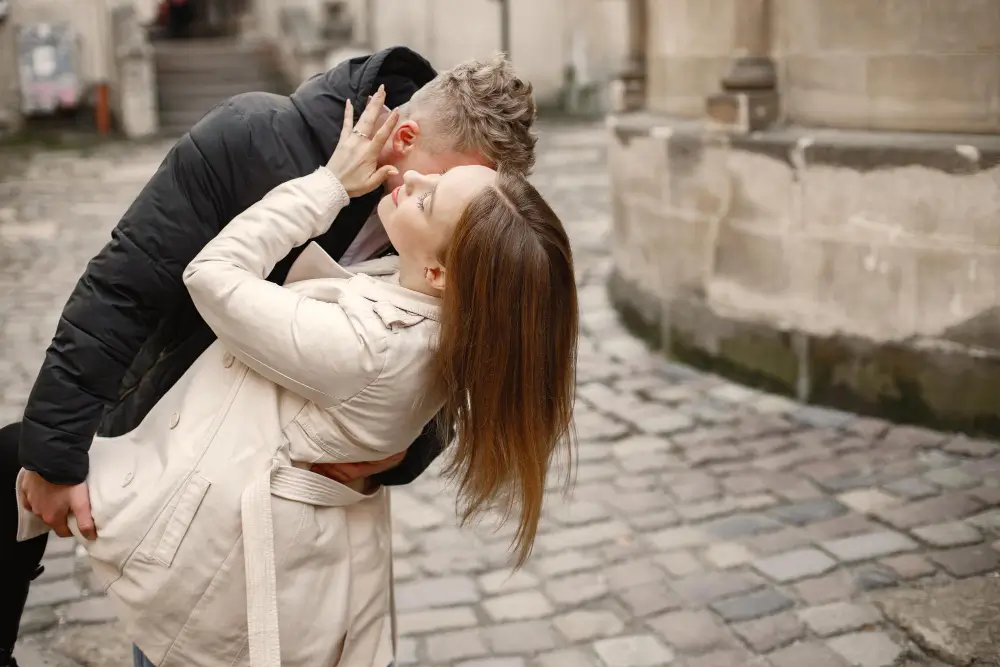
Dating Kiss Signals Before the Moment
Before a first kiss occurs, several signals usually appear. Dating kiss signals function as nonverbal communication that indicates readiness and intention without direct expression.
- Eye contact often intensifies. Prolonged or softened gaze suggests emotional focus. Distance decreases naturally as comfort increases. Physical orientation shifts toward closeness rather than avoidance.
- Pauses in conversation also matter. Silence before a kiss often feels charged rather than awkward. These pauses allow mutual awareness and confirmation without words.
- Body language provides additional cues. Leaning in, mirroring movements, and relaxed posture indicate openness. Tension or withdrawal suggests hesitation.
These signals rarely appear alone. Their combination over time forms a pattern that clarifies intent. Recognizing these cues reduces guesswork and helps interpret readiness accurately.
Also worth reading: How to recognize genuine love versus emotional dependence
Relationship Kiss Psychology Explained
Psychologically, a kiss reinforces emotional bonding by linking physical closeness with emotional experience. Relationship kiss psychology shows that the first kiss often anchors emotional memory.
A positive experience strengthens attachment by confirming mutual interest. It integrates physical sensation with emotional context, increasing connection. This explains why first kisses are often remembered vividly.
When the experience feels misaligned, emotional distancing may occur. Discomfort signals mismatch in readiness rather than failure. The brain associates the moment with tension rather than closeness.
Kisses also influence perception of compatibility. They act as emotional feedback rather than evaluation. The reaction reflects how safely closeness is experienced.
Understanding this psychology helps interpret reactions without overgeneralization. A first kiss reveals emotional alignment at that moment, not the entire potential of the relationship.
First Kiss Advice for Emotional Clarity
Approaching a first kiss with emotional awareness supports clarity rather than confusion. First kiss advice focuses on observation rather than assumption.
Emotional clarity begins with attention to mutual signals. Desire alone does not determine readiness. Awareness of emotional state, comfort level, and pacing matters.
Respect remains essential. Physical closeness should follow emotional openness, not precede it. When consideration guides action, trust strengthens regardless of outcome.
In contexts involving Ukrainian women genuine profiles, emotional respect often plays a significant role in perceived sincerity. Awareness of emotional cues supports mutual understanding and reduces misunderstanding.
Signs of the Right Moment for a Kiss
The right moment for a first kiss is rarely defined by a single signal. It emerges from a combination of emotional, behavioral, and situational cues that align at the same time. These signs reduce uncertainty and create a sense of mutual readiness rather than guesswork.
Sustained emotional engagement
One of the clearest signs is stable emotional presence. Conversation flows easily, attention remains focused, and neither side appears distracted or disengaged. Emotional engagement feels continuous rather than intermittent, indicating comfort and interest that extend beyond politeness.
Relaxed physical proximity
Physical distance naturally decreases when emotional comfort is present. Standing or sitting closer does not create tension, and personal space feels shared rather than defended. This relaxation signals that closeness is welcomed, not merely tolerated.

Mutual responsiveness
Responsiveness goes beyond verbal replies. It includes matching tone, pace, and energy. When both people adjust naturally to each other’s presence, interaction feels synchronized. This synchrony often precedes physical gestures because emotional alignment is already established.
Comfortable pauses and silence
Silence before a kiss often feels intentional rather than awkward. Pauses allow mutual awareness and create space for nonverbal confirmation. When silence feels charged but calm, it often signals readiness.
Absence of internal pressure
The right moment does not involve urgency or self-persuasion. There is no sense of obligation, performance, or fear of missing an opportunity. Instead, the moment feels optional yet natural, reducing emotional risk for both sides.
When these signs appear together, the kiss feels like a continuation of the connection rather than a test of it. Interpreting them as a whole provides clearer guidance than relying on any single cue.
Stay connected through the relationship strategy center to receive ongoing insights on loyalty, compatibility, and long-term planning. New posts are published regularly and help refine your standards. Clear standards prevent wasted time. When you are ready to act decisively, begin on the reliable international dating platform and start building real connections.
What is the “Escalation Ladder” of physical touch leading up to a first kiss?
The first kiss is rarely an isolated event; it is usually the culmination of a series of micro-escalations. From a behavioral perspective, this "Escalation Ladder" allows both partners to test the waters and establish consent non-verbally. It typically begins with "neutral" touch (tapping a shoulder), moves to "proximal" touch (sitting with thighs touching), and advances to "intentional" touch (holding a hand or brushing hair away from the face). Each step serves as a "diagnostic probe": if the partner leans in or reciprocates, the green light for the next step is lit.
When a kiss happens without this preparatory ladder, it often feels "forced" or "out of nowhere," triggering a startle response rather than a romantic one. Analytically, the "right" time is when the physical distance has been gradually reduced to the point where a kiss is the only logical next step in the interaction. In 2026, experts emphasize that "reading the room" is actually about reading this specific sequence of touch. If the ladder is climbed too quickly, it creates pressure; if it’s not climbed at all, the transition to a kiss feels socially awkward.
How do “Micro-Pauses” and the “Triangle Gaze” signal readiness for a first kiss?
There are two definitive non-verbal markers that a first kiss will feel "right." The first is the "Triangle Gaze"—a pattern where a person’s eyes shift from one of their partner’s eyes, to the other, and then down to the lips, before returning to the eyes. This is a subconscious signal of sexual interest and a mental rehearsal of the act. The second marker is the "Micro-Pause": a deliberate slowing down of speech and movement when in close proximity. This silence creates a "tension vacuum" that is naturally filled by a physical move.
If these markers are absent—for instance, if the conversation remains rapid-fire or the gaze is strictly eye-to-eye—a kiss will likely feel "wrong" or poorly timed. The "Triangle Gaze" acts as a silent question, and the partner’s response (often a slight parting of the lips or a mirror gaze) acts as the silent answer. Recognizing these micro-signals is crucial because they provide "social proof" of mutual desire, ensuring that the move is welcomed rather than merely tolerated.
Why does “Biological Compatibility” play a decisive role in the aftermath of a first kiss?
A first kiss is a massive sensory data exchange. Biologically, it allows the body to assess the partner's Major Histocompatibility Complex (MHC) genes through scent and saliva. This is an evolutionary mechanism designed to test for genetic compatibility. This explains why a kiss can "look" right on paper—both people are attractive and the setting is perfect—but "feel" wrong the moment contact is made. If the biological "fit" isn't there, the brain may trigger a subtle "disgust" or "indifference" response instead of a dopamine spike.
This is why many relationships end immediately after the first kiss. It isn't necessarily about "technique"; it’s about chemistry in the most literal sense. When it feels "right," the brain releases a cocktail of oxytocin, dopamine, and adrenaline, creating a "bonding high." When it feels "wrong" due to biological mismatch, no amount of romantic setting or previous conversation can override the body’s "no." Understanding this helps individuals not take a "bad" first kiss personally—it’s often just nature’s way of signaling a lack of long-term genetic synergy.
What are the “Red Flags” that indicate a kiss will feel uncomfortable or ill-timed?
A first kiss feels "wrong" when it ignores the "negative feedback" signals sent by the other person. These red flags are often subtle but consistent:
- Leaning Away: Even a slight backward tilt of the head or torso indicates a desire for more space.
- The "Closed" Barrier: Crossed arms or holding an object (like a bag or a drink) between the two bodies acts as a physical shield.
- Rapid Speech: Using "filler talk" to avoid silence is a common tactic to prevent a romantic moment from forming.
- Breaking Eye Contact: Constantly looking around the room or at a phone suggests a lack of focus and presence.
- The "Pat on the Back": If a hug ends with a platonic pat, it’s a clear signal that the person is not in a romantic headspace at that moment.
Ignoring these signals leads to "Contextual Mismatch." For example, attempting a kiss while someone is stressed about getting home or mid-sentence about a serious topic creates a jarring emotional disconnect. A confident move is not about being aggressive; it’s about being observant. When a person is not receptive, the "timing" is objectively wrong, and pushing through results in a loss of trust and rapport.
How does the “Setting vs. Sentiment” balance determine the memory of a first kiss?
There is a common misconception that a first kiss requires a "cinematic" setting—a sunset, a bridge, or a rainy street. However, analytical data shows that "Sentiment" (emotional alignment) is far more important than "Setting" (the environment). A first kiss in a crowded, noisy bar can feel "right" if the emotional intimacy is high, whereas a kiss at a luxury viewpoint can feel "wrong" if the connection is superficial.
The setting should ideally reflect the "internal state" of the relationship. If the bond is playful and adventurous, a spontaneous kiss in a fun environment works. If the bond is deep and intellectual, a quiet, private moment is better. When the setting and sentiment are aligned, the kiss feels like a natural "anchor" for that memory. When they are misaligned—such as a grand romantic gesture after only 20 minutes of conversation—the kiss feels "performative" and creates a sense of inauthenticity.

Maria is a writer who specializes in couples counseling and encourages people to become more intimate with one another. If you come across informative articles with personal viewpoints or research-based pieces that highlight the stages of creating healthy relationships, these pieces are probably written by Maria. The author emphasizes the importance of self-growth before seeking a romantic partner.